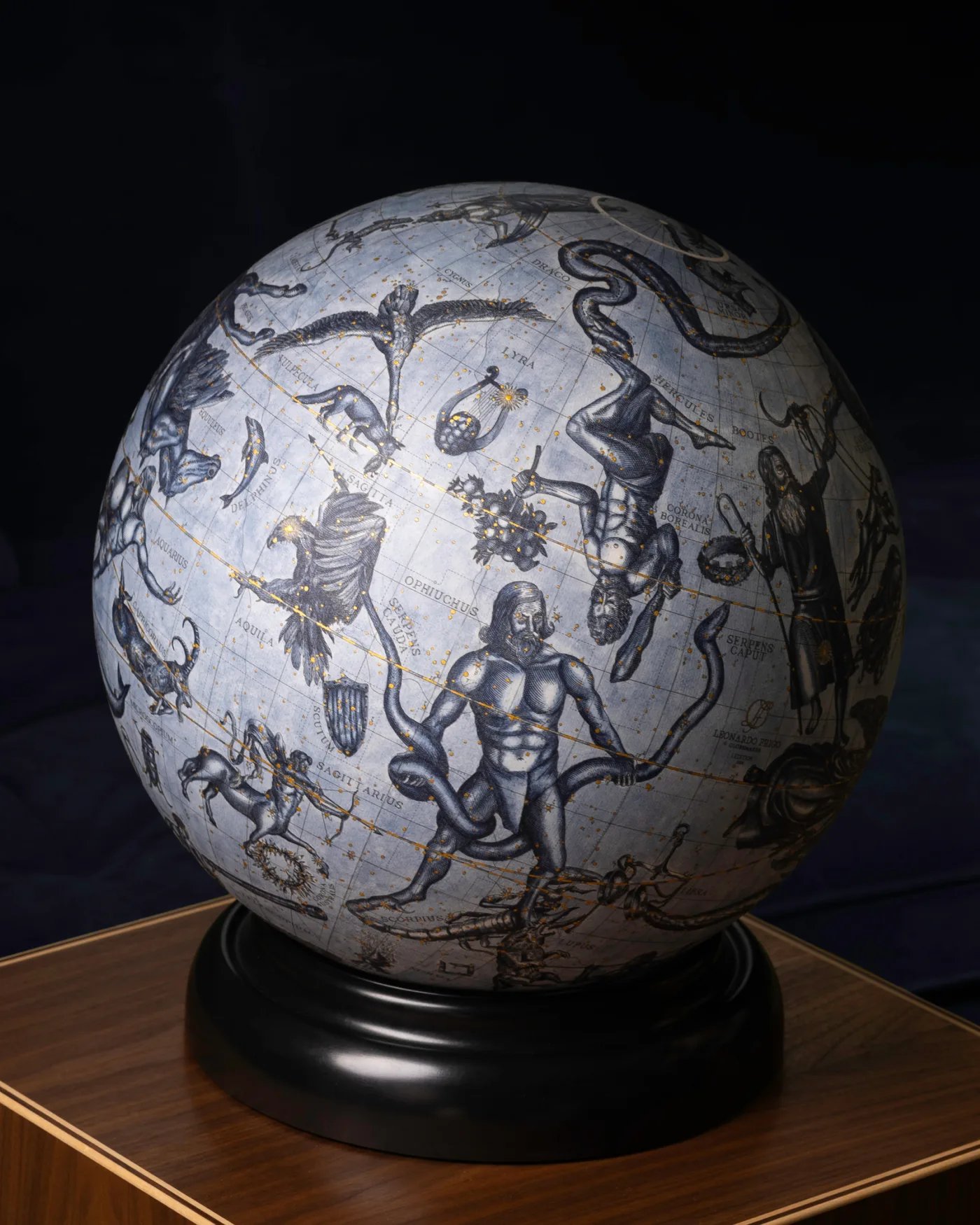
Aries – Myth, Astronomy and Celestial Mapping
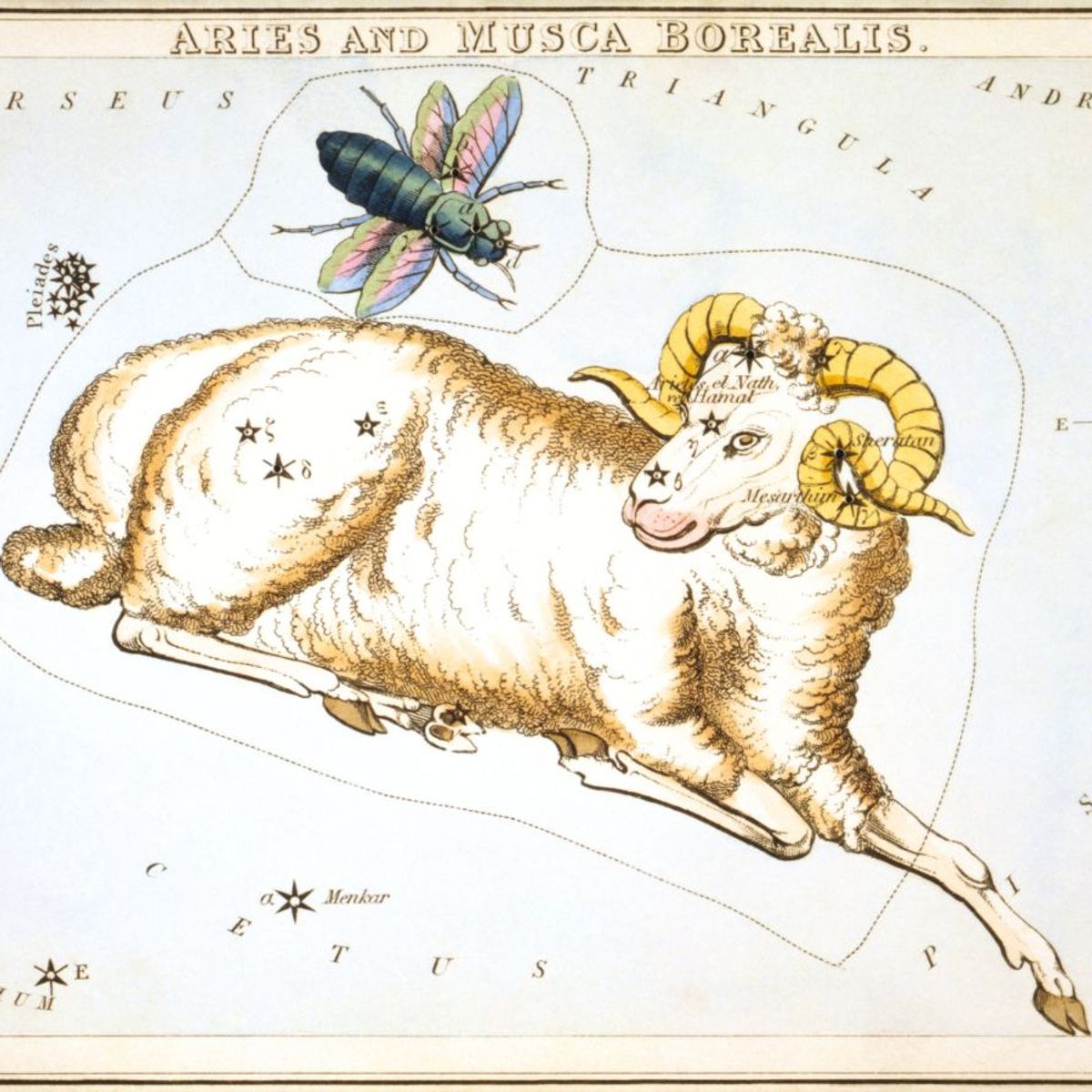
Located between the celestial bodies of Pisces and Taurus in the Northern Hemisphere, the constellation of Aries stretches wide across the sky, evoking the image of a powerful creature in motion.
First among the zodiac, a group of twelve constellations that align with the sun's apparent path across the sky, it represents a meeting point between science, myth, and celestial observation. It has been well known among the ancient and modern constellations since antiquity thanks to Ptolemy, who listed it in his celebrated astronomical treatise Almagest.
Its Latin name Aries harks back to the ram, a reference to the mythological creature. It has been depicted in various ways by multiple astronomers, one of whom, Hevelius, portrayed it from an inverted and external perspective.
History, Myth and Symbolism
Although it is believed that Aries derives from Greek mythology, its origins date back to the Babylonian zodiac. This system was also known as the “MUL.APIN”, shaped by a table of the rising and settings of stars, which likely served as an agricultural calendar. It’s in this instance that we recognize the constellation with the name of "The Agrarian Worker".
The constellation was in fact associated with Dumuzi, a shepherd god associated with renewal and seasonal cycles, a symbol of rebirth and transition that shaped the celestial figure in later cultures such as the Egyptians and Greeks, which became the most enduring narrative of the constellation.
In Egyptian astronomy, Aries was associated with the god Amun-Ra, depicted as a man with a ram's head, which became a symbol of fertility and creativity. During the times of the year when it was most prominent, priests carried statues of Amun-Ra in procession to temples, earning them the title "Lord of the Head".
In Hellenistic mythology, the constellation is associated with the golden ram that, on the orders of Hermes, saved Phrixus and Helle, leading Phrixus to the land of Colchis. They were the children of King Athamas and his first wife Nephele.
But the story takes a turn for the worse when Ino, the King's second wife's jealously set in motion a plan to kill the two. She caused a famine in Boeotia, then falsified a message from the Oracle of Delphi that Phrixus must be sacrificed to end the famine.
Athamas was about to perform the deed atop Mount Laphystium when Ares arrived. She fell from Ares's back during the flight and drowned in the Dardanelles. Phrixus, however, reached Colchis safely. In gratitude he sacrificed the ram to Zeus and offered its gleaming fleece to King Aeetes, who hung it in a sacred grove guarded by a dragon.
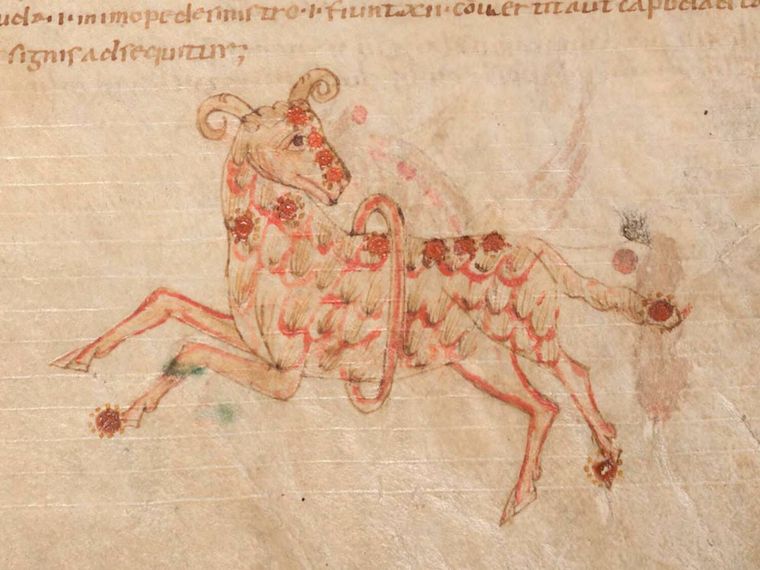
The story of the Ram thus intertwines sacrifice and heroic adventure. It is thanks to Greek myth that many medieval manuscripts depict the constellation with its head turned toward Pisces, an association that remains deeply rooted in today's culture.
How to Recognise Aries in the Sky
Alongside mythology, astronomy has made great progress since ancient times. The position of Aries has become crucial, allowing us to easily locate it from our planet. The constellation is most visible on autumn and winter evenings in much of the northern hemisphere of Europe, and can be seen as a curved line illuminated by three main stars: Alpha (Hamal), Beta (Sheratan), and Gamma Arietis (Mesarthim).
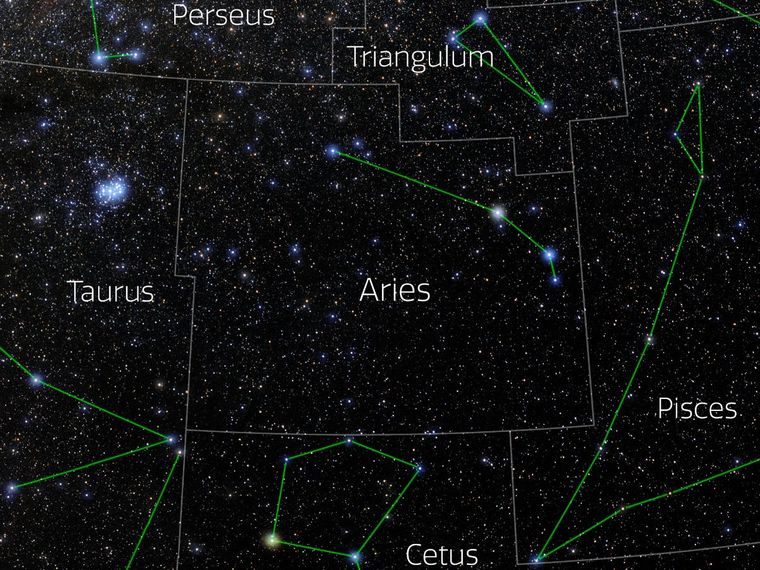
Hamal serves as a guide to the entire constellation, as it’s the brightest star. But to find it, the practical advice is to first locate the Great Square of Pegasus, a huge dark rectangle with very few bright stars within it.
From the lower right corner, draw a line downward: Aries lies just beyond, forming a delicate yet elegant silhouette. Surprisingly, the constellation is easier to find in low-light conditions because the stars Hamal and Sheratan remain visible at all times.
Aries is also bordered by several constellations that help people locate it immediately. To the west lies Pisces, whose star Alrescha, marking the knot of the two fishes, is often used as a reference point: from there, a slight deviation east leads directly to the starry arc of Aries.
To the east lies Taurus, a much brighter and more prominent figure, identifiable thanks to the red giant Aldebaran. Moving the gaze westward, the line of Aries is revealed.
This combination of a powerful constellation and a more modest one has helped astronomers orient themselves for centuries. To the north, the constellation touches Triangulum, a small triangle of stars, and to the south, the constellation borders Cetus, whose shape contrasts with the minimal line of the celestial pattern.
Aries between Science and Meteor Shower
Aries main stars all share an intense brightness. This is because they are so close to Earth that we could call them our neighbors. All three possess this characteristic for different reasons: Hamal is an orange giant, which naturally radiates much more light than the Sun; Sheratan is a warm star that radiates a bluish-white light; and Mesarthim is a binary system, meaning that two stars contribute to its brightness.
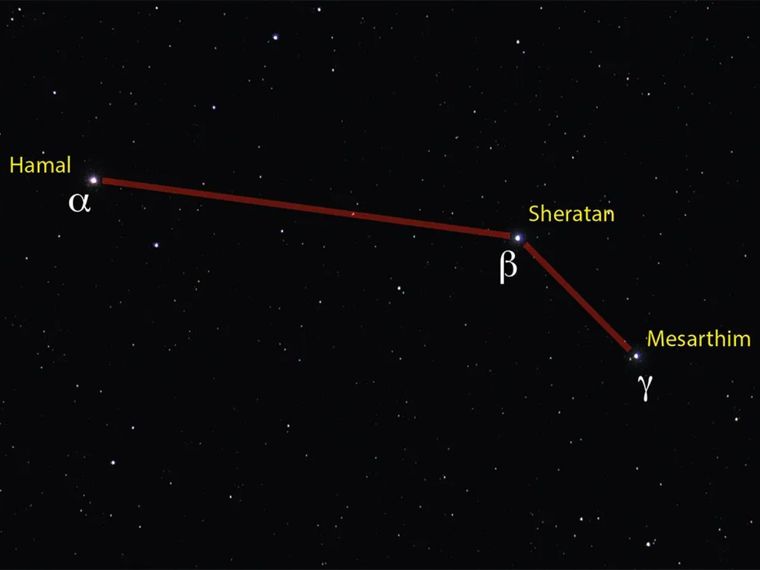
Together they form an asterism, a group of stars visible in the night sky, recognizable by their geometric shape. Seen from our planet, a constellation is a region of sky, so we should think of these shapes as a group of stars that appear connected only from our point of view, their patterns shaped by our perspective.
Aries hosts several interesting phenomena, one of which is its meteor shower. Every year, from May 22nd to July 2nd, it's possible to witness the dawn of the Arietids, one of the most intense meteor showers ever. This peaks on June 7th, with meteors visible before dawn, appearing at a rate of 1-2 per hour and lasting several seconds.
But meteors aren't the only noteworthy phenomenon in Aries. The constellation contains several stars with exoplanets. One of these is orbited by three giant planets with a mass more than ten times that of the Earth. Another is a star slightly larger than the Sun, orbiting two planets.
Cultural Value Over Time
Aries has always been recognized as a vital figure by artists, cartographers, and globemakers around the world. In ancient astral charts, the constellation often appears as an animal radiating strong power, represented by compact muscles, with its head upturned in a poised position ready to leap.
Before assuming the form of a ram, Mesopotamian society often depicted it as a farmhand. The Babylonians later linked it to the spring equinox and agricultural fertility. There is no original source, but the illustration of the ram became a symbol as it was copied and transcribed in later manuscripts, astronomical treatises, and medieval codices.
Vincenzo Coronelli, a famous 17th-century Italian cosmographer, depicted Aries in elaborate detail, intertwining stylized, curved horns with thick wool, and positioned in mid-stride, symbolizing the bold energy and rebirth of spring as handed down by ancient myths.
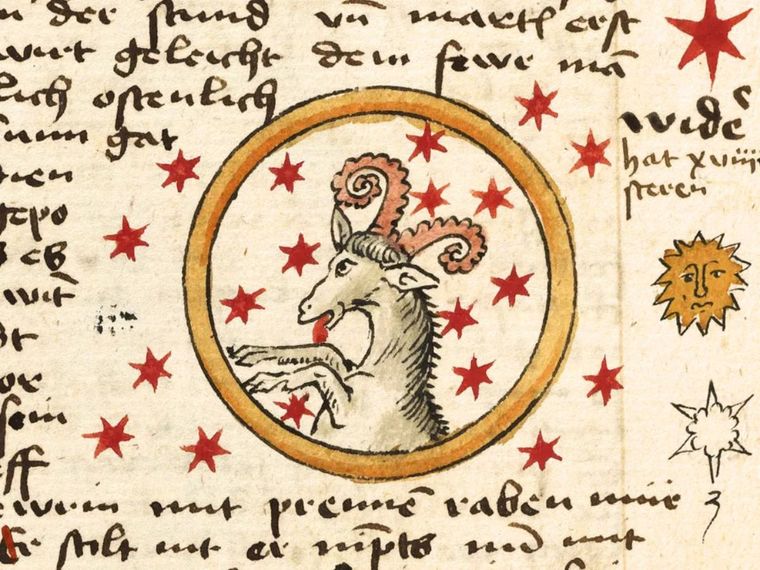
Other famous representations come from Johannes Bayer and Johannes Hevelius, both of whom contributed enormously to the study of the constellations. Bayer's Uranometria presents Aries as a simplified creature, while Hevelius, who drew his figures from an inverted perspective to show them from outside the celestial sphere, gave Aries a more naturalistic form.
These demonstrate how each artist and cartographer brought their own unique style and objectives, adapting the same star cluster to different aesthetic traditions, each adding their own cultural nuances.
For contemporary globemakers like myself, Aries continues to fascinate for its creative depth and historical component, offering a distinct image between astronomy and art, a dialogue between past and present.
A Reflection on Cosmology and Art
This constellation represents new beginnings in the realm of astrology. It marks the start of the evolution of cosmology, and although modern astronomy no longer connects Aries to agricultural and seasonal themes, its symbolic nature remains intact.
Myths have highlighted crucial themes that enhance the human essence, such as protection and sacrifice, highlighting the collaboration between culture and renewal, such as that of the spring equinox, which still endures in many polytheistic cultures.
This constellation is also associated with divine masculine energy, ruled by Mars, the red planet. In pagan traditions, Aries represents action-oriented masculine energy, often linked to deities of war, protection, and agricultural fertility.
All these symbols are obviously the work of human beings who project their hopes towards the sky, seeking something distant but still visible, a quest that guides history, imagination and creativity.
Aries stands firm thanks to the work of cartographers and globemakers from around the world, whose passion for the stars continues to keep this constellation, rich in history and meaning, alive.
Its stars trace a fairly minimal line, but perhaps that's also what makes it so interesting. The night sky is full of curved shapes and celestial objects mapped on astronomical charts and treatises, but Aries stands out for its breathtaking elegance.
The universe is a gallery of encounters between myth, history, and science, a veil that extends to infinity, creating patterns that seem tailor-made to be admired from down here.
Aries is just the first of 88 constellations to explore on this journey together. Each contains a world of celestial art waiting to be rediscovered. I invite you to follow this series step by step: let the night sky reveal itself, star after star, story after story.
FAQ
Why is Aries a zodiacal constellation?
Aries is located among the zodiac because ancient astronomers designated it as the starting point of the solar year.
How far away are the main stars of Aries?
Hamal, Sheratan, and Mesarthim are all within 50-70 light-years, placing them in our local stellar neighborhood.
Related Topics
Are you fascinated by the world of astronomy? Then celestial globes will tell you something more! Read here to continue your journey.