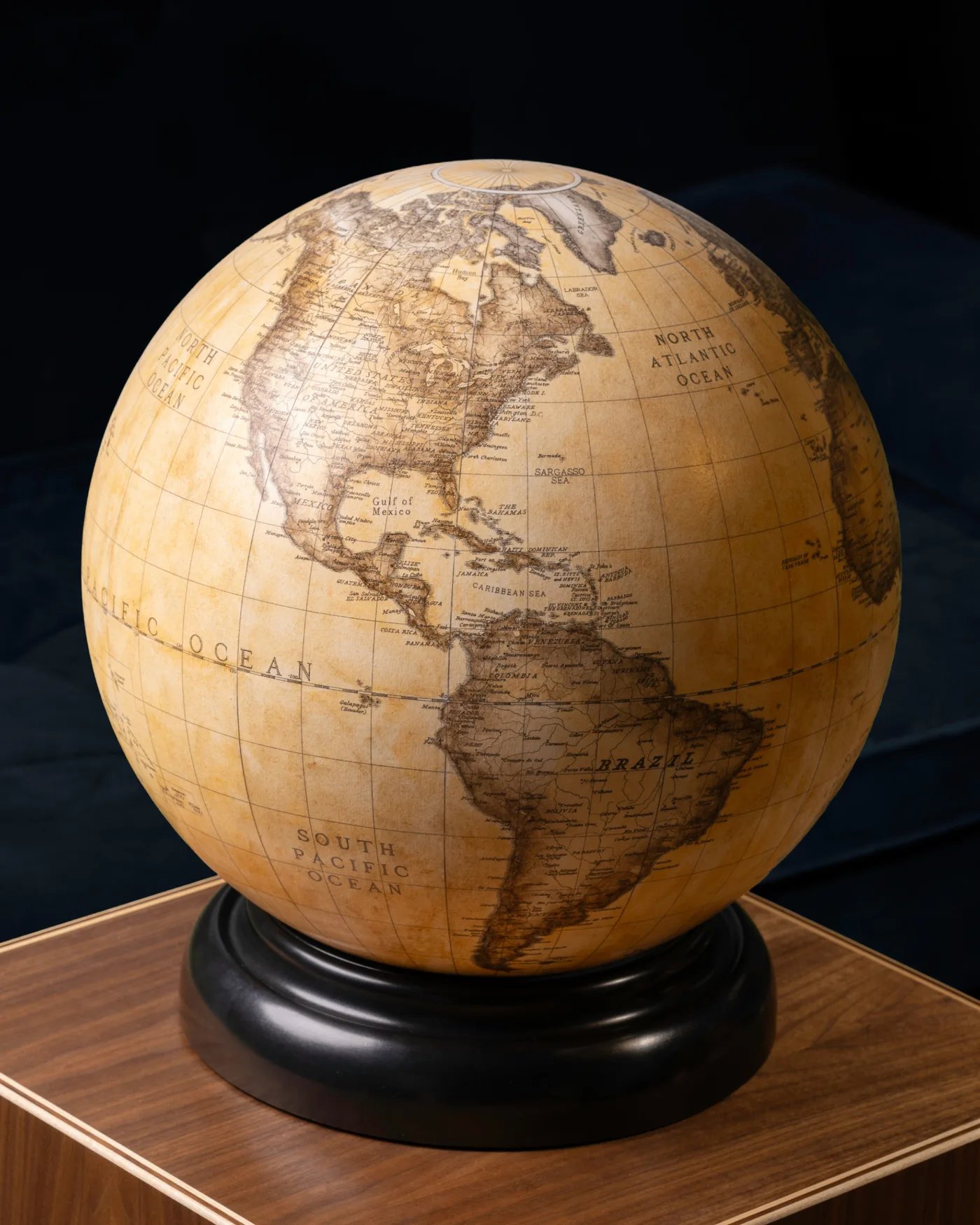
The Art of the Spherical World – Coronelli’s Legacy at the National Library of France
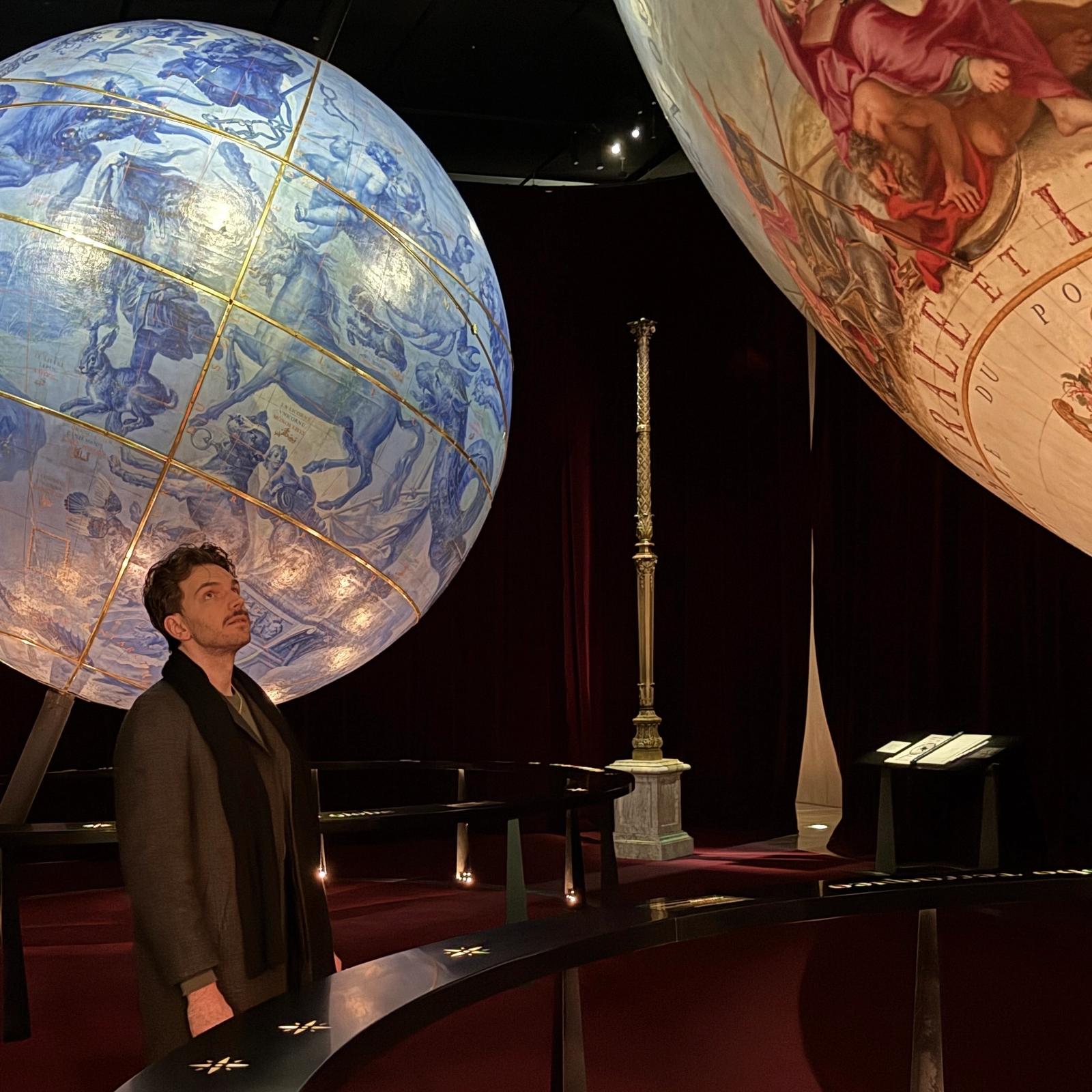
I had been preparing for this moment for years, without exaggeration. Countless books, archival documents, sketches, and technical studies had shaped my understanding of Vincenzo Coronelli's work. Over time, I began tracing his lines, measuring proportions, and trying to decipher the logic of his brushstrokes. Yet, no book or historical manual had prepared me for the moment I would finally stand before his colossal celestial and terrestrial globes at the Bibliothèque nationale de France, François-Mitterrand's headquarters.
As a globe maker, I certainly felt a strange mix of reverence and curiosity, almost as if I had met a distant ancestor whose genius has silently shaped the lives of all of us through his incredible influence. I was able to see and confirm that his globes are worlds constructed with a precision and ambition that still challenge us today. And the closer I got to them, the more I felt the same awe that Coronelli must have wanted to inspire more than three centuries ago, gazing before me at imposing creations measuring over four meters in diameter.
For me, this was an encounter intertwined with the history, technique, and personal reflections of someone who has dedicated his life to the art of creating objects with scientific, artistic, and astrological functions—a craft that requires patience, curiosity, and the willingness to lose oneself in the slow, meditative process of shaping a world with one's hands.
It is also the story of how a single moment, facing two monumental spheres created more than three centuries ago, can illuminate an entire artistic journey, reminding me why I chose this path and how deeply connected I remain to the lineage of the artisans who came before me.
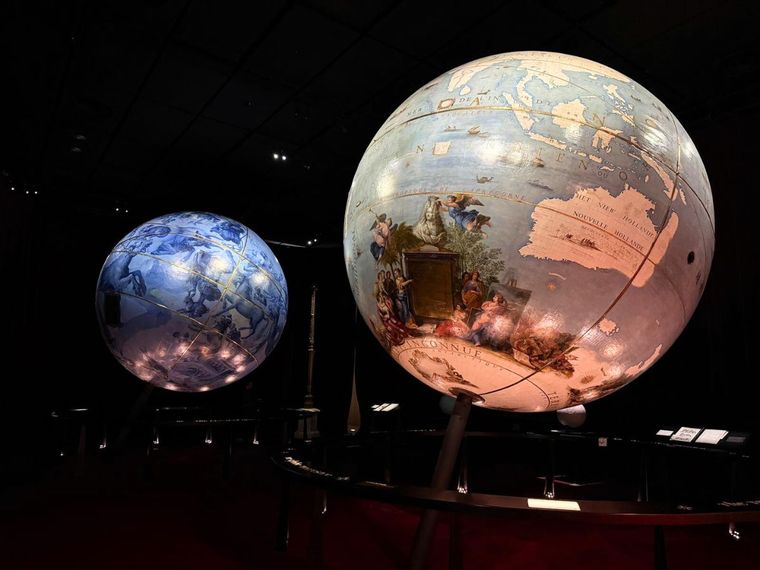
From left to right: the celestial and terrestrial globes created by Coronelli for the Sun King
A Commission Fit for the Sun King
To understand the grandeur of these celestial and terrestrial globes, we must go back to the late 17th century, when Europe was a stage for power, spectacle, and scientific ambition.
In 1681, Cardinal César d'Estrées, a diplomat, patron, and close ally of the French crown, commissioned Coronelli to create a pair of monumental globes as a gift to Louis XIV. The Sun King was at the height of his glory, and nothing better symbolized his reign than emblems that combined knowledge, art, and political power. It’s important to note that these globes were never intended as simple scientific instruments. At the time, they were considered the king's voice, a sorta of statement of value, and thanks to their magnificent theatricality, they boasted an unmistakable regal presence.
The globes were originally intended to be brought to the Château de Marly, Louis XIV's private retreat, where only a select few were invited. Imagine the impact: entering a room where two immense spheres, each over four meters wide, dominated the space like celestial bodies captured and tamed for the king's pleasure. They were, in every sense, objects of power. They represented the world as France wished to see it: orderly, illuminated, and centered on the Sun King.
Unfortunately, however, the globes were never installed at the Château de Marly due to their size: they were so heavy that transporting and storing them proved impractical. They were therefore installed at the Tuileries Palace in Paris. Later, during the 18th century, they were moved again, traveling through various royal and national collections. After the French Revolution, they were transferred to the Bibliothèque du Roi, then to the Bibliothèque nationale. Their size made them difficult to display, and for a long time they remained hidden from the public eye, preserved like sleeping giants.
Only with the construction of the François-Mitterrand site of the Bibliothèque nationale de France did they finally find a permanent home worthy of their beauty. Today, they are housed in a dedicated space, carefully lit and meticulously preserved, and also accessible to anyone wishing to make the pilgrimage.
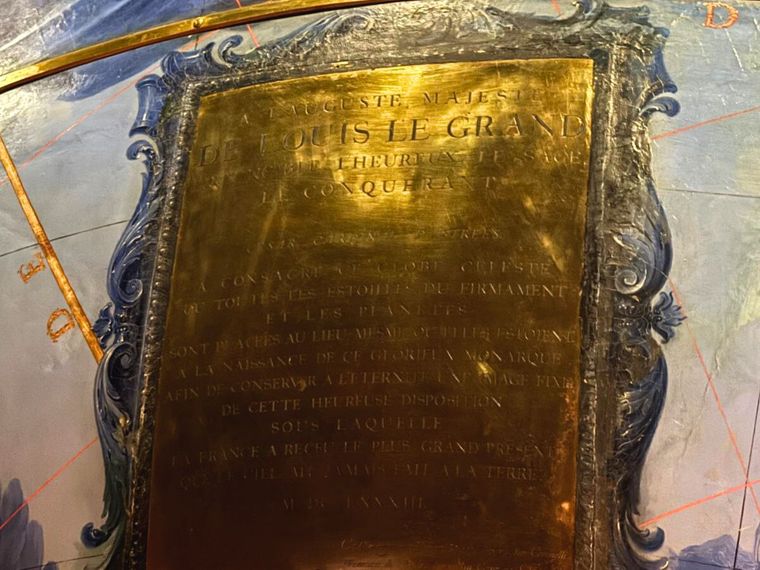
Close‑up of the Coronelli's inscription, created as a tribute to the King
The Terrestrial Globe: A World on the Edge of Discovery
Standing before the globe, I felt as if I were witnessing a moment of transition. Coronelli completed it in the late 17th century, when vast territories were still being mapped, contested, or imagined. The Americas, in fact, still appear with coastlines that are at once familiar and strangely uncertain. It's also fascinating how Australia, known as the "New Holland," was only partially drawn, and the interior of Africa was left largely blank, a reminder of how much of the world was still unknown to Europeans.
But what makes this globe extraordinary, in my opinion, is Coronelli's privileged access to the French cartographic archives. Thanks to Cardinal d'Estrées and the favor of Louis XIV, he was allowed to consult maps and documents normally reserved for the king's geographers. This access thus granted him an unprecedented advantage, unwittingly creating a synthesis of the most advanced geographical knowledge of his time.
For the artist, this commission was transformative. It elevated him from a skilled Venetian craftsman to Europe's most celebrated globe maker. The techniques, social networks, and prestige he achieved at the French court shaped all his subsequent globes, including the famous series produced for European aristocrats and scientific institutions.
As I gazed back over the painted edges, I felt a deep connection to the challenges he must have faced: how to represent uncertainty, how to balance aesthetics and precision, or how to shape a world still in flux. The parallels with my own life are striking, because these are questions I grapple with in my work, centuries later.
The Celestial Globe: A Sky Frozen for a King
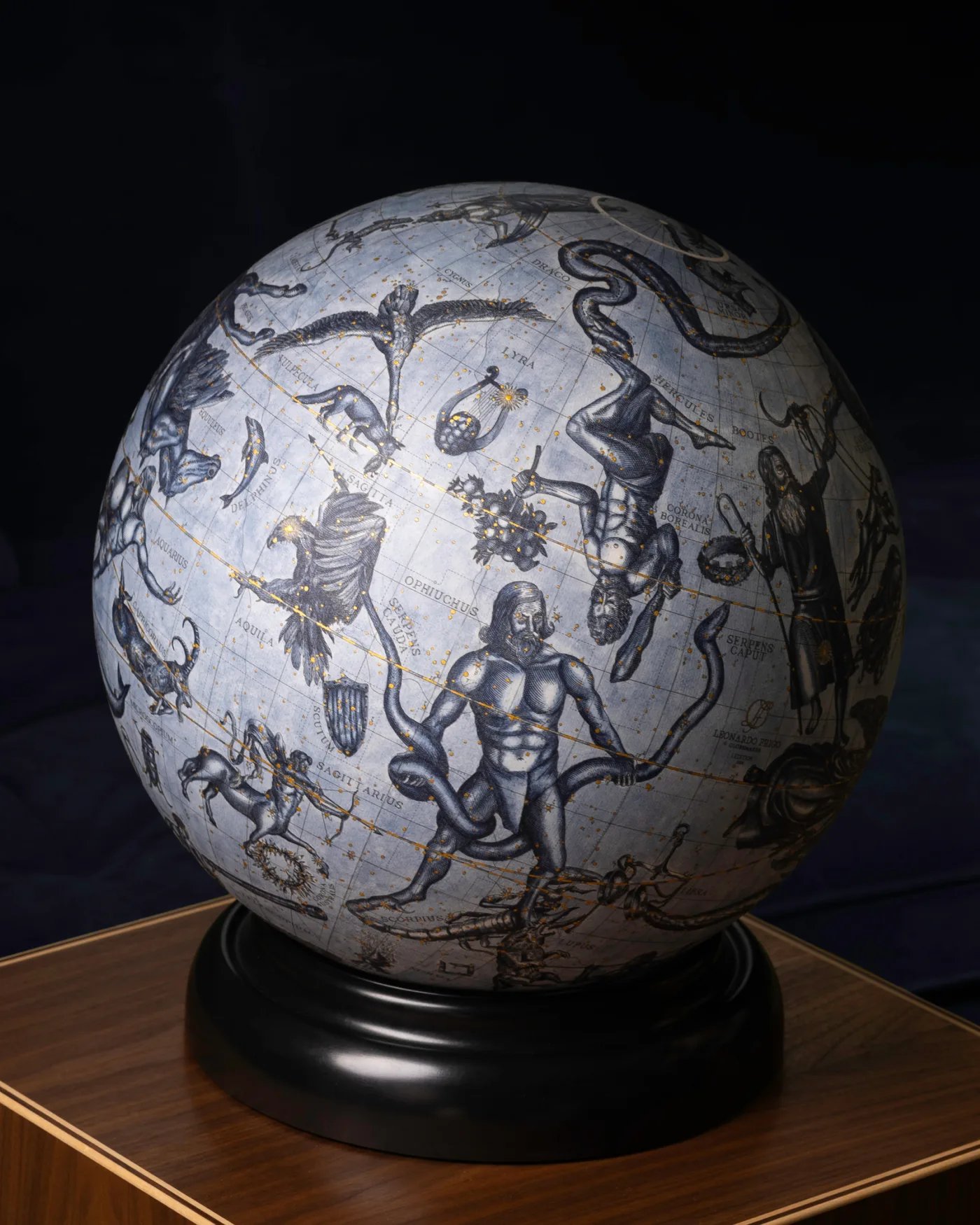
If the terrestrial globe represents the world as humans knew it, the celestial globe represents the heavens as remembered by Louis XIV. In this second work, Coronelli painted each constellation in extraordinary detail: mythological figures, animals, heroes, and celestial symbols swirled across the sphere, like a cosmic fresco. But the most striking detail is the position of the Sun on the ecliptic: set in September, the month of Louis XIV's birth.
The sky is literally frozen at the moment the Sun King came into the world. So here we are, no longer just talking about astronomy, but about political cosmology. The heavens themselves are arranged in honor of the monarch, and thus the celestial globe becomes a metaphor: the King at the center of the universe, his destiny inscribed in the stars.
Only after this reflection did I realize I felt the weight of this symbolism. Coronelli wasn't simply mapping the sky; this time, he was able to develop a narrative through myth. Yet, within all of this, there was a true scientific rigor thanks to the precision of the constellations, with carefully calculated positions and harmonious proportions.
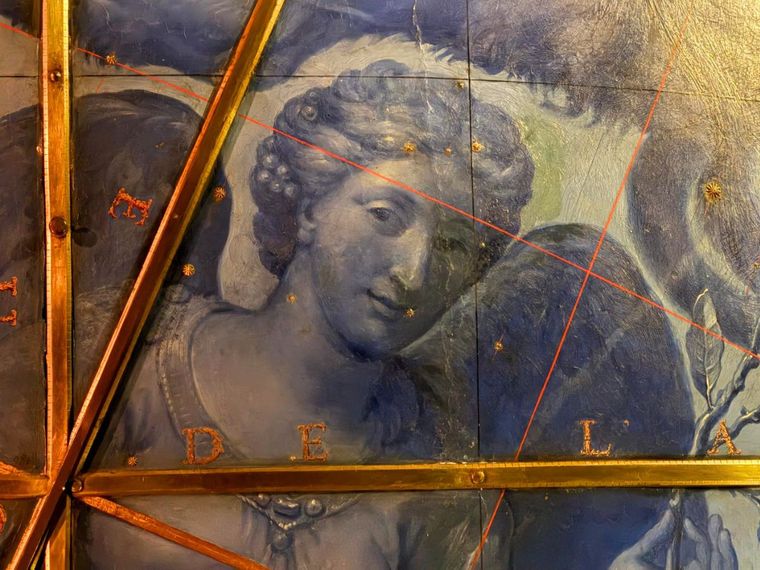
Virgol, one of many constellations across the celestial globe
A Construction Technique Ahead of Its Time
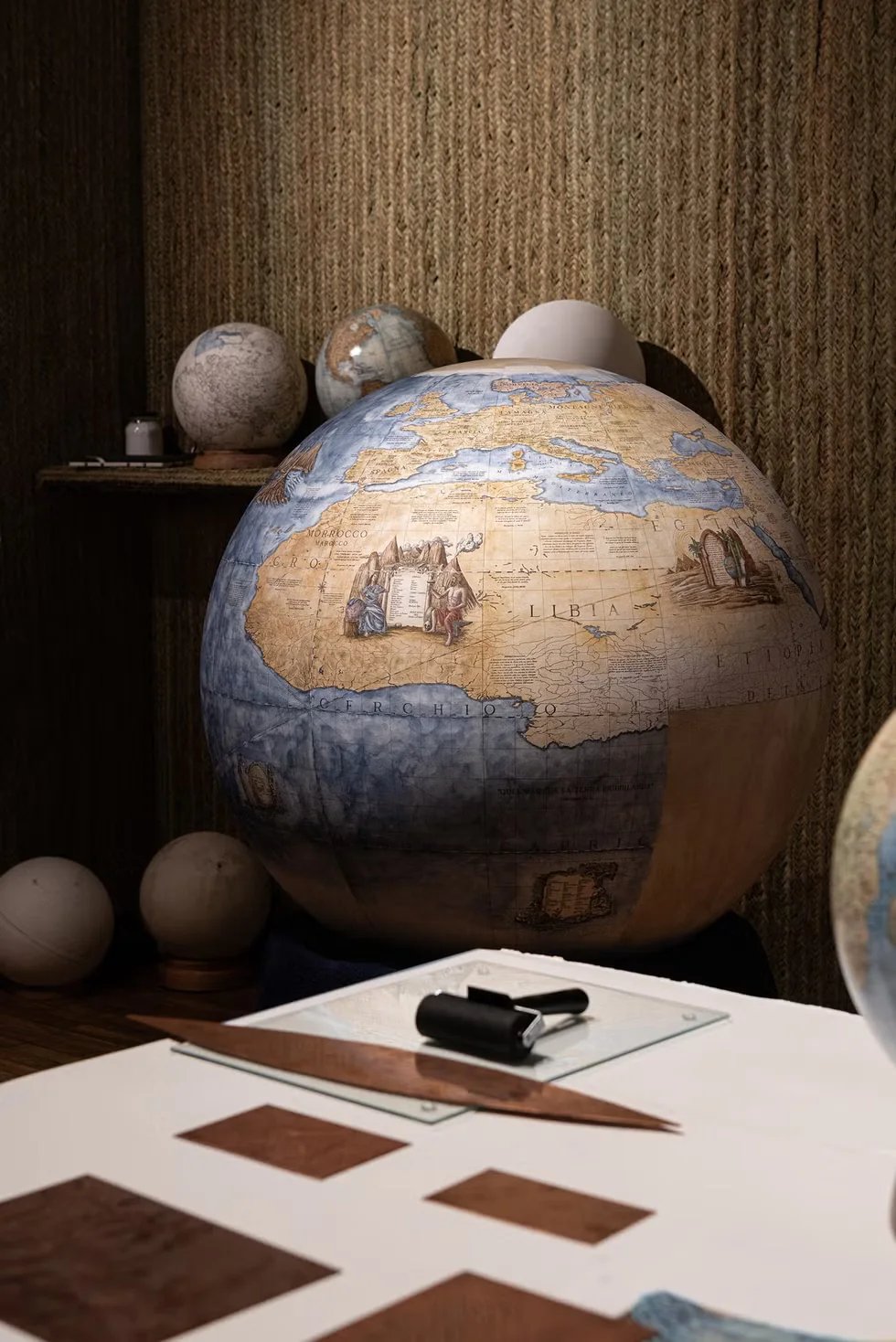
One of the most fascinating aspects of Coronelli's globes is their construction– a process that reveals not only technical mastery but also an almost sculptural approach to cartography. Unlike many globes of the time, which relied on segments of printed paper glued to a spherical surface, these giants were conceived as purely painted objects.
Their images are not merely on the surface of the sphere, but are an integral part of it. The continents, constellations, decorative cartouches, and flowing inscriptions emerge directly from the layers of plaster, lending the surface a tactile unity that printed globes could never fully achieve. As you approach, you sense that the painting and the structure are inseparable, as if the world and the sky had been sculpted and then colored, rather than assembled from fragments.
The internal structure itself is a marvel of engineering of the time. A sturdy wooden skeleton forms the core: a lattice designed to support the immense weight of the finished sphere. Above this structure, Coronelli applied layers of raw jute, chosen for its strength and flexibility, stretching it tightly to create a continuous skin. Only then was the plaster applied, applied in successive layers, each smoothed and refined until a perfect, uninterrupted surface was achieved. This meticulous preparation was essential: any irregularity would distort the painted geography or celestial coordinates.
Once the plaster had hardened, Coronelli painted directly onto it, working with pigments that bonded to the surface and allowed for fluid transitions, delicate shading, and extraordinary detail. The result was a surface that appears alive, subtly textured, and remarkably consistent despite its age. But the most striking feature, which still captures my attention, is the presence of trapdoors. These openings, so cleverly integrated into the structure that they might be overlooked at first glance, allowed the cosmographer to enter the globe whenever he wanted to work on it from the inside.
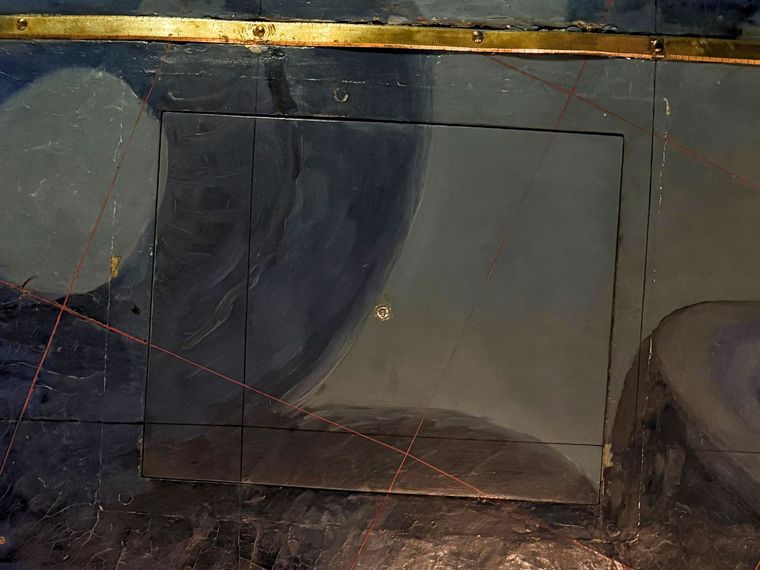
One of the hatches used by Coronelli to work from inside the globe
Standing before the globes, I photographed these trapdoors, knowing what they represent: the ability to enter one's own creation. I imagine Coronelli climbing through the narrow opening, perhaps with a lantern in hand, illuminating his work with a warm, flickering light. He would then be surrounded by the curved wooden ribs of the structure, the hollow echo of his movements amplified by the spherical chamber. From this vantage point, he could reinforce the plaster, control its curvature, or even paint sections from the inside out. The globes have an intimate, almost secret dimension, speaking to the physicality of their creation, and it would be a dream to be able to experience those moments.
As a globe maker, this detail deeply moved me. I know the intimacy of working on a sphere, the way the body must adapt to its curvature, the way the arm learns to follow a line that is never straight, but always gently bends away from you. There's a physical dialogue between artist and object, a negotiation of balance, scope, and perspective.
But entering the world, and literally being inside it, must have been a transformative experience. It's a level of immersion that few artists achieve, a moment when the boundary between creator and creation dissolves. Coronelli didn't just paint the celestial globe– for a brief moment, he inhabited it. And there, gazing at those trapdoors, I felt a profound connection to that act of total artistic surrender.
Real‑Life Impressions: The Presence of a Giant
The photographs I saw before my visit certainly didn't prepare me for the physical sensation of standing before these globes. Their sheer size is overwhelming in a way only the presence of a monumental object can be: an encounter that engages the eyes, nose, and hearing. These senses helped me contemplate the dominance these works represent in the room, capturing attention with the silent authority of ancient giants.
Yet, despite their mass and grandeur, they do so with an unexpected elegance, rather than an intimidating air. Their proportions are harmonious, their surfaces so fluid that their size almost becomes secondary to the grace with which they inhabit the space. One has the sensation of approaching something alive, something that breathes history and intention and has patiently awaited the arrival of new viewers for centuries.
The surface is remarkably seamless. The painted plaster has aged, of course, but the transitions between colors and shapes remain fluid. One can see the brushstrokes, the layers, the subtle variations in tone. The surface has a softness that flake prints could never match.
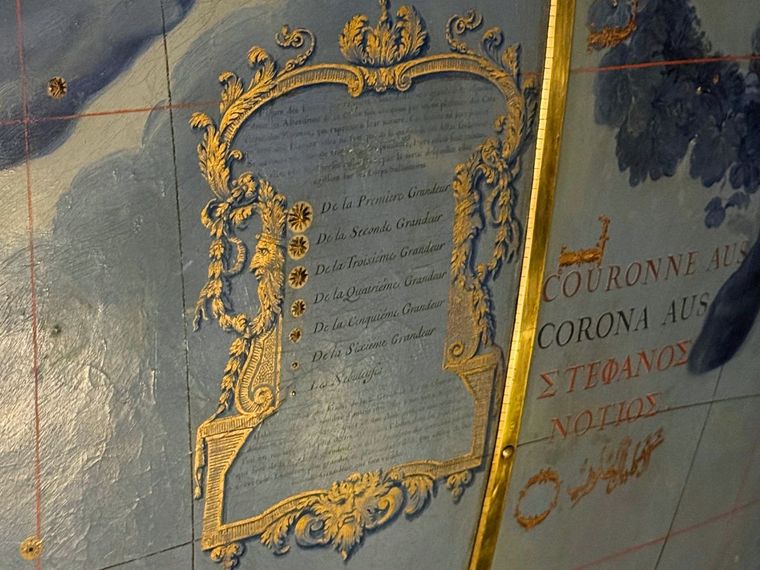
Detailed view of the terrestrial globe showcasing decorative elements
I found myself walking slowly around it, almost drowsily, as if orbiting a planet. Every angle revealed new details: a ship caught in a storm, a mythical creature, a delicate line marking a meridian. I took at least a dozen photos, with close-ups and wide shots capturing its monumentality, including the magnificent hatches, and every small– but certainly not boring detail.
But more than anything, I was touched by a profound sense of continuity. The artist's hands once touched this surface, his eyes measured these curves, and his imagination filled these spheres with meaning. And here I was, centuries later, standing before the same objects, learning from them and drawing inspiration.
A Beacon for Future Globemakers
Ultimately, both globes are a total celebration of Louis XIV. They glorify his power, birth, mighty reign, and his vision of the world. They are monuments not only to knowledge, but also to its political use. They remind us that maps and globes are never neutral, but always shaped by the hands, minds, and intentions of those who create and commission them.
For me, as a contemporary globemaker, this encounter was more than a historical visit, but a dialogue across time. Coronelli's ambition challenged me to think bigger. His precision pushed me even further to refine my techniques, and his ability to blend art, science, and narrative inspired me to continue exploring the expressive potential of globes. Every globe is a world, but it is also a narrative. The centuries-old cartographer understood this better than anyone.
As I walked out of the Bibliothèque Nationale de France that day, I felt a sense of renewal, invigorated by the presence of these four-meter-diameter giants, honored by their craftsmanship, and grateful for the artisanal tradition that unites us. I realized that these globes are living objects, still capable of teaching, inspiring, and arousing wonder. And for me, they remain a guiding light, a reminder that the world, in all its complexity, can be held in our hands, shaped by imagination, and shared with others through the timeless art of globemaking.