Discovering the Astrolabe – A Cosmos in the Palm of the Hand
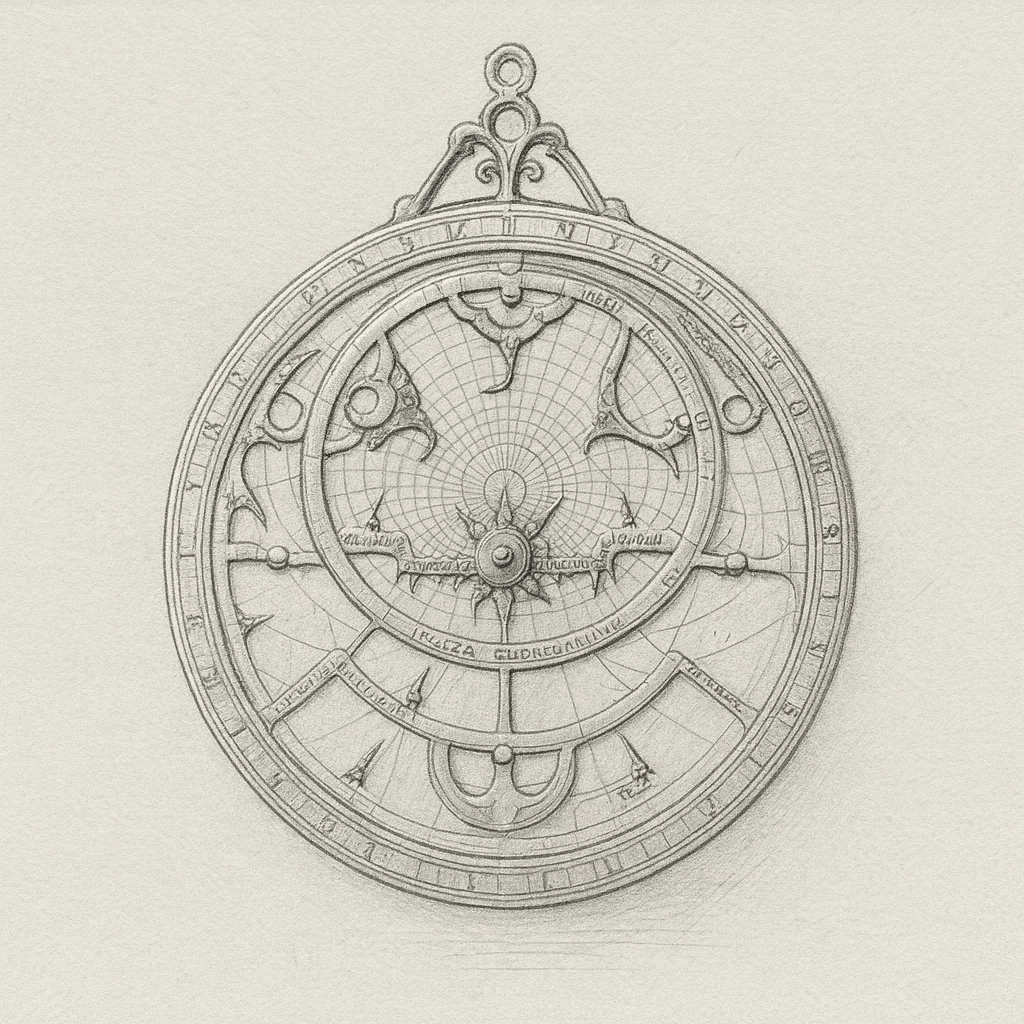
Under the night sky, long before the invention of telescopes and satellites, people searched for ways to bring the stars closer. The astrolabe emerged as their solution: a beautifully crafted disc of bronze, a tool one could hold in one's hand.
Between Roles and Memories
It served as part star chart, calculator, and work of art, condensing the cosmos into brass. While its origins can be traced back to ancient mathematicians' experiments, its legacy extends across the world and the decks of ships that ventured into unknown oceans.
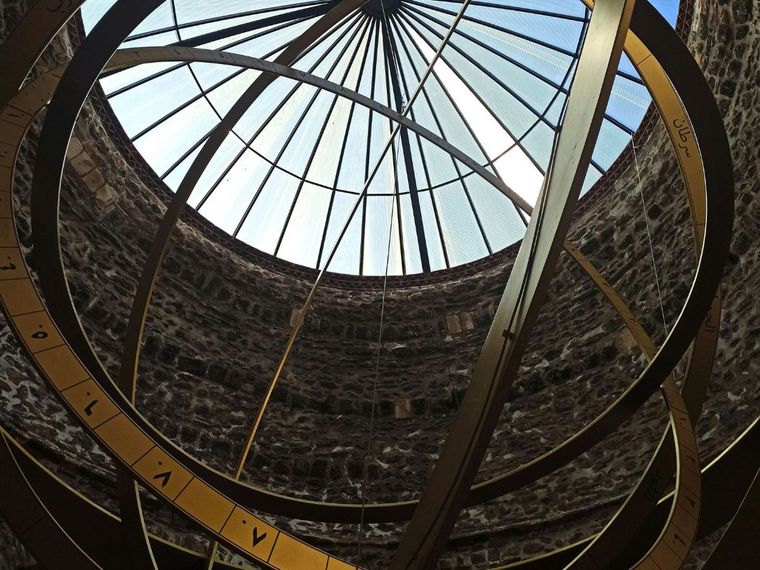
Photo by Gülçay Çumak
The earliest roots of the astrolabe can be traced to the Mediterranean, where Greek scholars wrestled with the challenge of mapping the sky onto a flat surface.
The principle of stereographic projection, explained by Ptolemy in the second century CE, offered a solution. Although no physical examples of the first astrolabes exist, treatises indicate that early astronomers experimented with instruments that foreshadowed later designs.
These efforts laid the foundation for what would become one of the most versatile scientific devices of the pre-modern era.
Form and Function
But the astrolabe isn't a simple poetic symbol; it's a scientific instrument. Its flat, usually circular device made of brass or bronze was designed to represent the sky in two dimensions.
By rotating its parts, one could calculate the position of the Sun, Moon, and stars, determine the time of day or night, and even establish latitude for navigation. In essence, it served as an early analogue computer, condensing complex astronomical knowledge into a handheld tool.
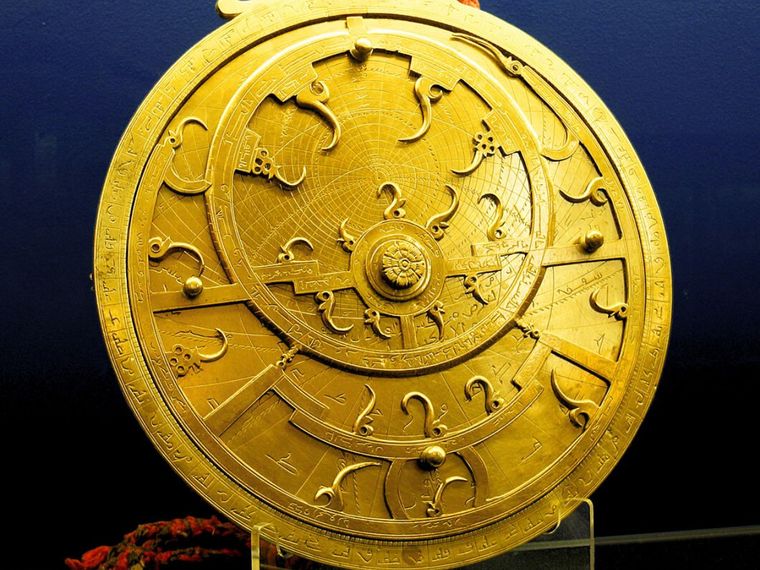
Photo by Andrew Dunn - 18th Century Persian Astrolabe
Breakdown of Components
Above these elements is the rete, a rotating framework that outlines the ecliptic and key stars and often adorned with decorative pointers.
By rotating it, users can track the apparent motion of celestial bodies, making the device act as a star chart and a tool for calculations.
The back of the mater typically carried scales for time, calendars, or trigonometry, along with an alidade– an adjustable sighting rule used to measure the altitude of the Sun or stars.
Some astrolabes also featured shadow squares for surveying and height measurement. Makers often inscribed their names, dates, or patrons on the instrument, leaving historians valuable records. As one of the oldest scientific tools, the astrolabe combined artistry with practical astronomy and navigation.
Flourishing in the Golden Age
Between the eighth and thirteenth centuries, Islamic scholars refined the astrolabe into a versatile instrument. Figures such as al-Farghani and al-Sufi wrote treatises on its construction and use, ensuring its spread across the Islamic world.
The astrolabe was used to determine prayer times and ascertain the direction of Mecca, thus intertwining the realms of astronomy and daily religious practices. It allowed its users to accurately track celestial movements, which was essential for Muslims to perform their prayers at the designated times throughout the day.
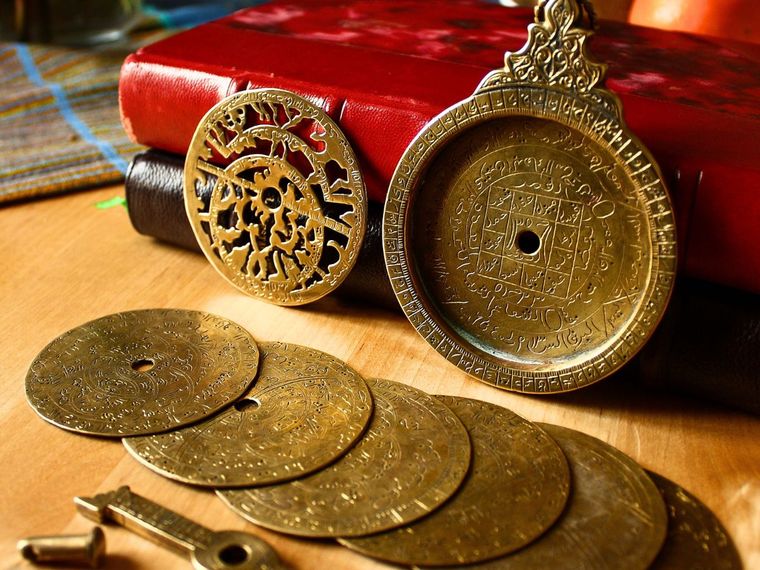
Disassembled 18th Century Astrolabe
A Useful Learning Tool
In addition to its practical applications, the astrolabe served as an invaluable teaching resource, introducing scholars to the fundamental concepts of geometry and trigonometry. Through its usage, apprentices could visually grasp complex mathematical principles and their real-world operations.
Moreover, the craftsmanship of the astrolabe was a testament to the harmony of science and art, as its intricate designs not only reflected scientific precision but also showcased the artistic beauty of the cultures that created them. Each piece was often embellished with elaborate engravings and decorations, making it a memorable work of art to be admired.
Transmission to Medieval Europe
The astrolabe was introduced to Europe through translations of Arabic texts during the medieval period. By the twelfth century, this device had established itself as an essential tool in universities across the continent, facilitating astronomical and navigational studies. Notably, the well-known poet Geoffrey Chaucer recognised its significance and even authored a treatise on the astrolabe for his son.
In Europe, the astrolabe was held in high esteem, valued for its functional capabilities and as a mark of intellectual prestige. These instruments symbolised the pursuit of knowledge and the interwining of cultures during a time when the quest for understanding the universe was paramount among the educated elite.
Over the years, a durable version was designed for sailors. Constructed from heavy brass with cutouts to minimise wind resistance, this instrument enabled navigators to measure the altitude of the Sun or stars above the horizon, which helped determine latitude. Although it couldn't address the issue of longitude, the mariner’s astrolabe was essential for ocean voyages and played a significant role during the Age of Discovery.
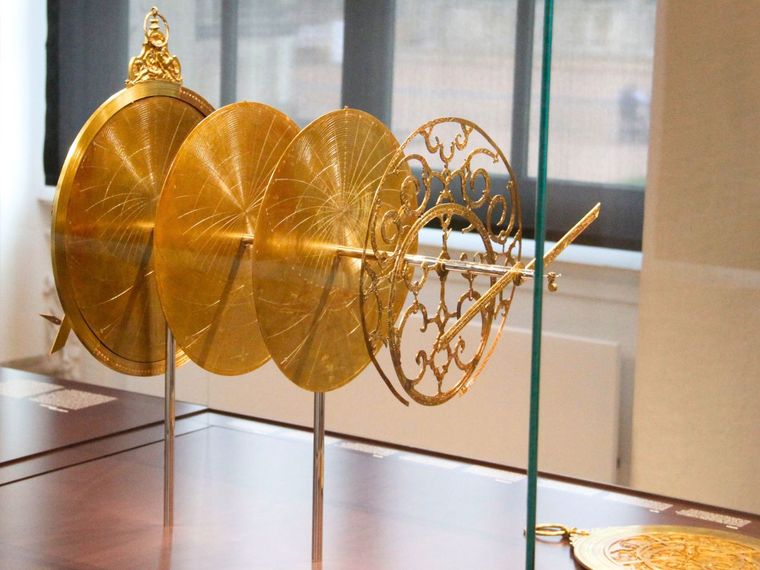
Exploded View of an Astrolabe
Symbolism and Legacy
Beyond its practical functions, the astrolabe carried symbolic weight. To own one was akin to holding a fragment of the cosmos itself, a tangible representation of humanity’s ability to measure and comprehend the vastness of the universe.
Its crafted engravings often featured intricate inscriptions, heartfelt prayers, or personal dedications, each telling a story and echoing the culture from which it originated. These details inscribed the instrument with a sense of history and meaning, making it a reputable object of both science and memories.
Decline and Enduring Appeal
By the seventeenth century, newer instruments like the telescope and sextant provided greater precision, leading to a gradual decline in the use of the astrolabe. However, it didn't completely vanish. It continued to serve as a teaching tool and a collector's item.
Museums such as the British Museum in London and the Museum of the History of Science in Oxford hold notable collections where visitors can admire the astrolabe's craftsmanship and envision the hands that once operated it beneath the stars.
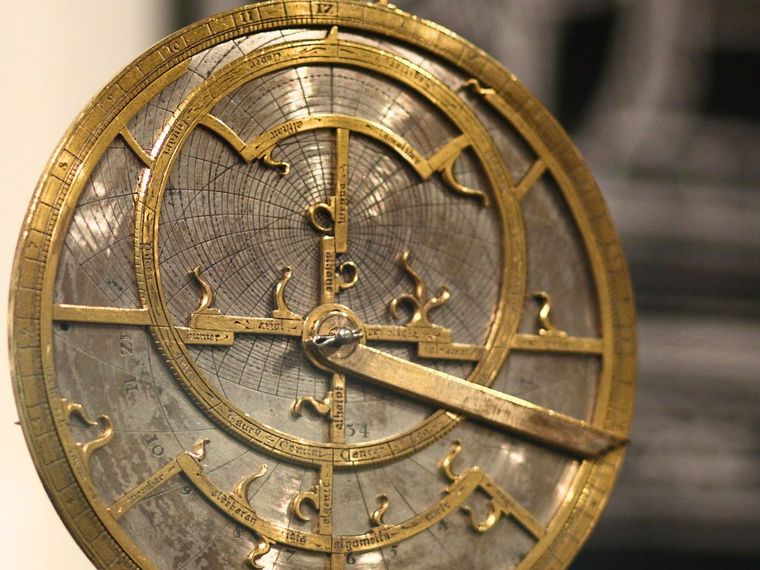
Jean Fusoris Astrolabe - Made in Paris, 1400
A Bridge Across Cultures
The astrolabe serves as a profound symbol of a specific worldview: one that embraces the idea that intricate and multifaceted wonders can be held in the palm of one's hand. In today's era, heavily influenced by digital technology, this ancient tool invites us to appreciate the elegance of analogue estimation and the skill involved in solving complex problems through the principles of geometry and mechanics.
It weaves together the contributions of Greek mathematicians, Islamic scholars, European poets, and adventurous seafaring explorers, uniting them in a common pursuit to unlock the mysteries of the heavens above.
The astrolabe defines the idea that celestial bodies can be mapped and that knowledge about them can be physically represented. Spanning across various cultures and historical periods, it highlights that science involves not only the act of discovery, but also the connections it fosters among people, cultures, and the cosmos.