The Art of Handmade Globes: Inside Leonardo Frigo’s London Studio
Leonardo Frigo is an Italian artist and globe maker based in London who creates handmade terrestrial and celestial globes inspired by the cartographic traditions of the 17th century. This article explores his studio, his process, and the story behind the Dante Alighieri's Globe.
In a quiet studio in London, an ancient object slowly takes shape: the globe. Here Italian artist and globe maker Leonardo Frigo works on the creation of handmade globes, inspired by the great cartographic tradition of Europe. His work brings together art, history and craftsmanship, reviving techniques that date back centuries.
Each globe is the result of a long and meticulous process involving engraving, printing, painting and careful assembly. Rather than using modern digital printing methods, Frigo studies historical sources and traditional techniques once used by the great cosmographers of the past.
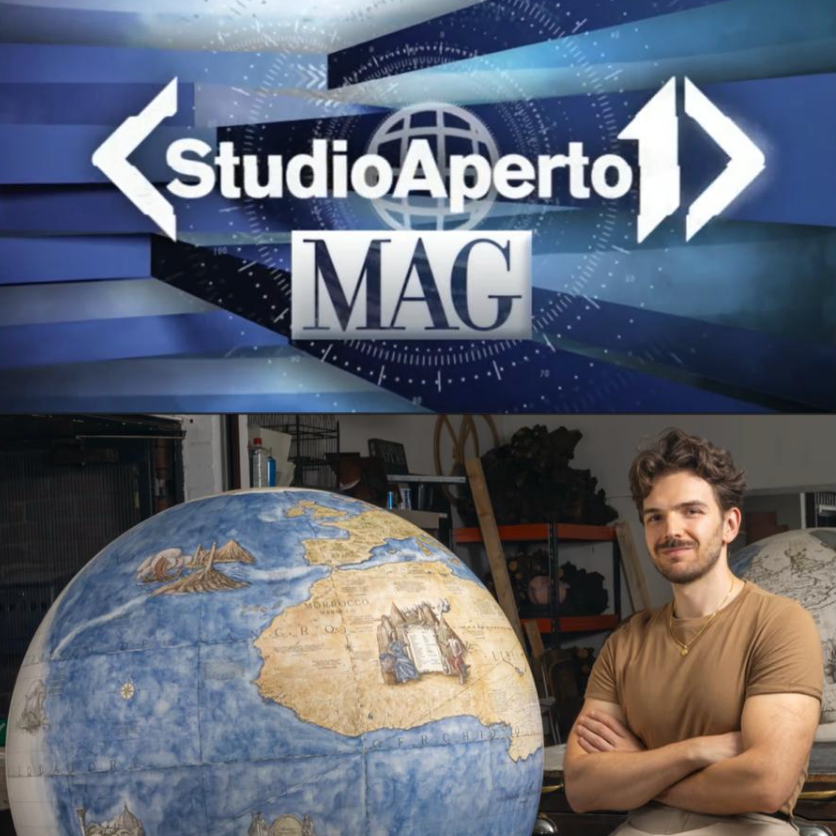
This evening (4th March) his work will also be featured on Italian television. A report filmed in his London studio will be broadcast on Italia 1 as part of the program Studio Aperto MAG. The feature offers viewers a rare look inside the workshop where these unique globes are created.
But how exactly is a handmade globe made? And why would a contemporary artist devote years of research to rediscovering such a rare craft?
An Italian Artist Rediscovering the Art of Globe Making
Leonardo Frigo is an Italian artist who lives and works in London. His artistic practice explores the intersection between art, history and cultural research. Throughout his career he has often drawn inspiration from historical narratives and intellectual traditions.
Before beginning his work on globes, Frigo gained recognition for an unusual artistic project inspired by Dante Alighieri’s Divine Comedy. In that series he painted scenes from Dante’s Inferno directly onto violins, transforming musical instruments into narrative works of art.
This exploration of history through artistic media eventually led him to cartography. Fascinated by how people in the past represented the world, Frigo began studying the tradition of historical globe making.
His research brought him to the works of one of the most famous globe makers in history: the Venetian cosmographer Vincenzo Coronelli. In the seventeenth century Coronelli produced some of the largest and most detailed globes ever created, combining scientific knowledge with extraordinary artistic craftsmanship.
Inspired by these historical masterpieces, Frigo set out to revive the forgotten techniques used to construct globes centuries ago.
The Tradition of Handmade Globes
Today most maps exist in digital form, accessed through smartphones and satellites. Yet for centuries the globe was one of the most important scientific instruments used to understand the world.
A globe is more than a decorative object. Historically it represented the most accurate way to visualize the Earth and the heavens. Scholars, navigators and explorers relied on globes to study geography, astronomy and navigation.
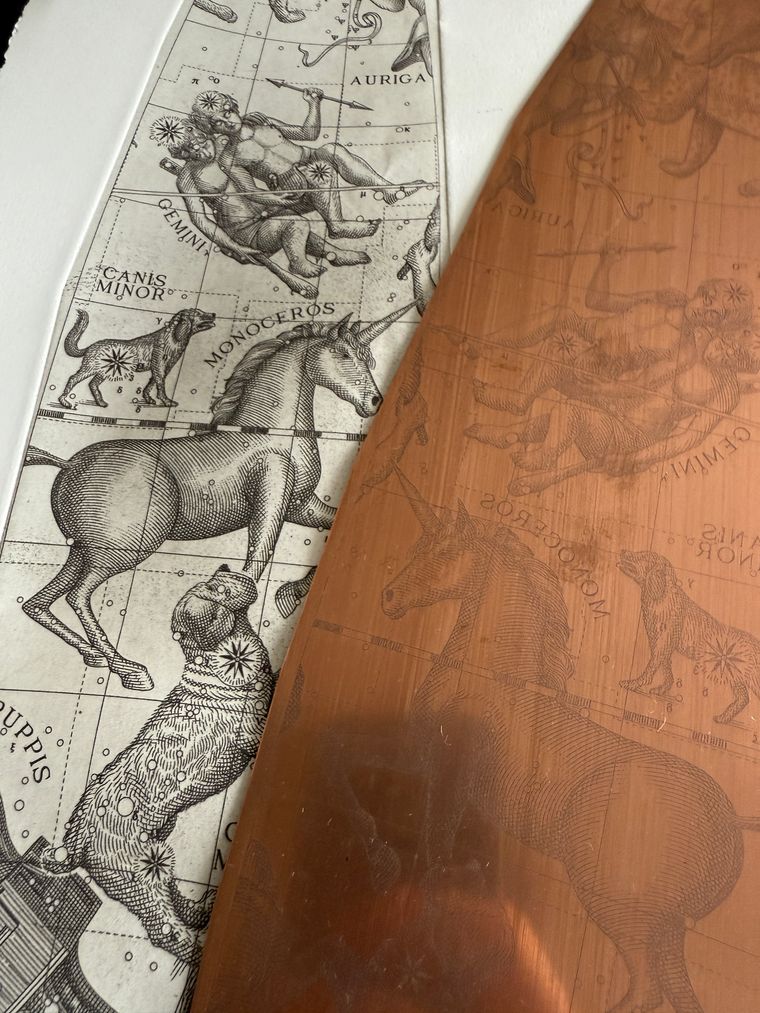
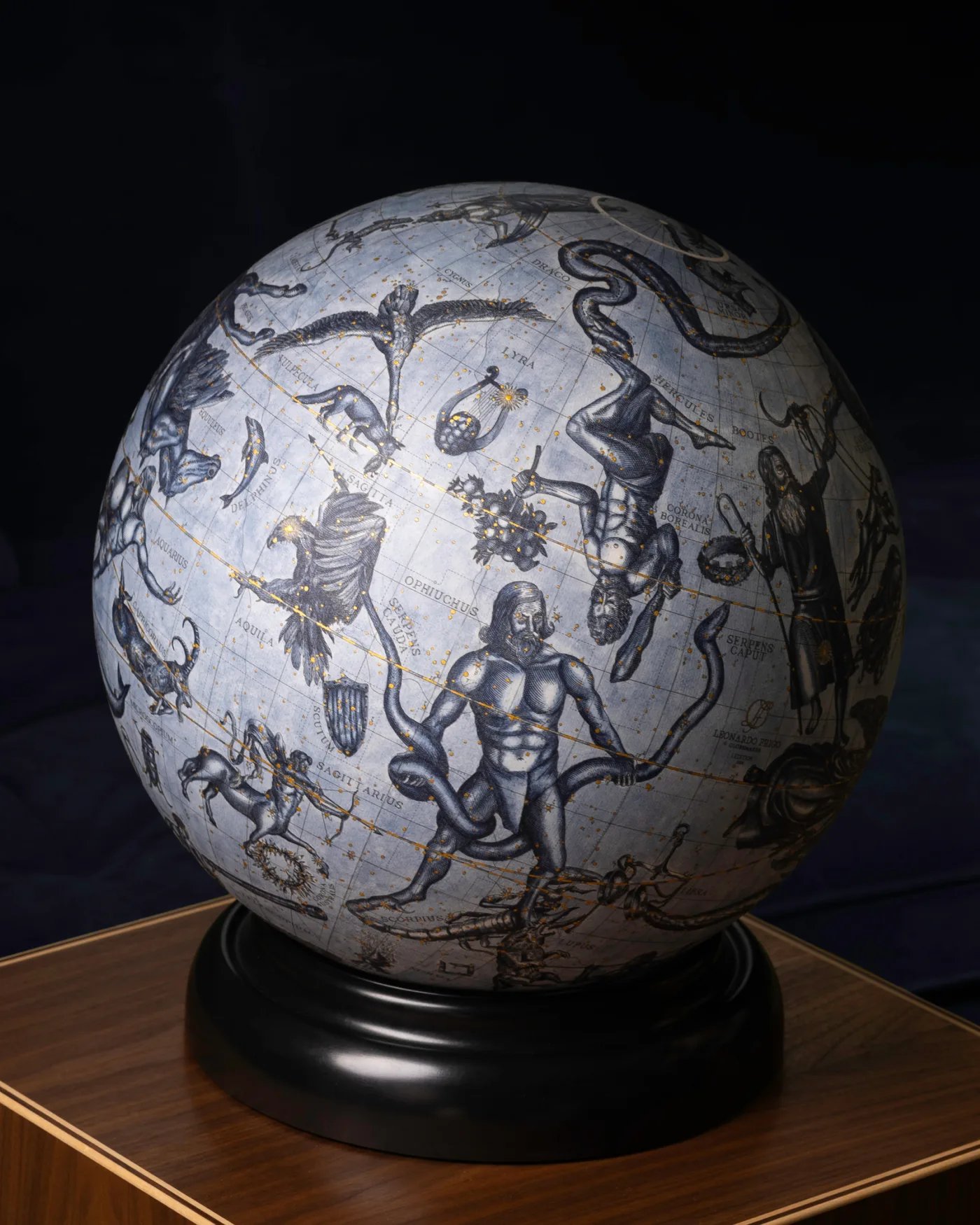
Celestial map
Creating a globe required the collaboration of several specialized crafts. Cartographers designed the maps, engravers carved them into copper plates, printers produced the impressions, and artisans assembled the final sphere.
The maps themselves were printed in segments known as “gores.” These curved strips of paper were carefully applied to a spherical surface to form the globe.
Although technology has advanced dramatically since then, the fundamental principles of globe construction have remained remarkably similar.
How a Handmade Globe Is Created
Inside his London studio, Leonardo Frigo follows a process that echoes the practices of historical workshops. Each globe begins with the design of the maps themselves.
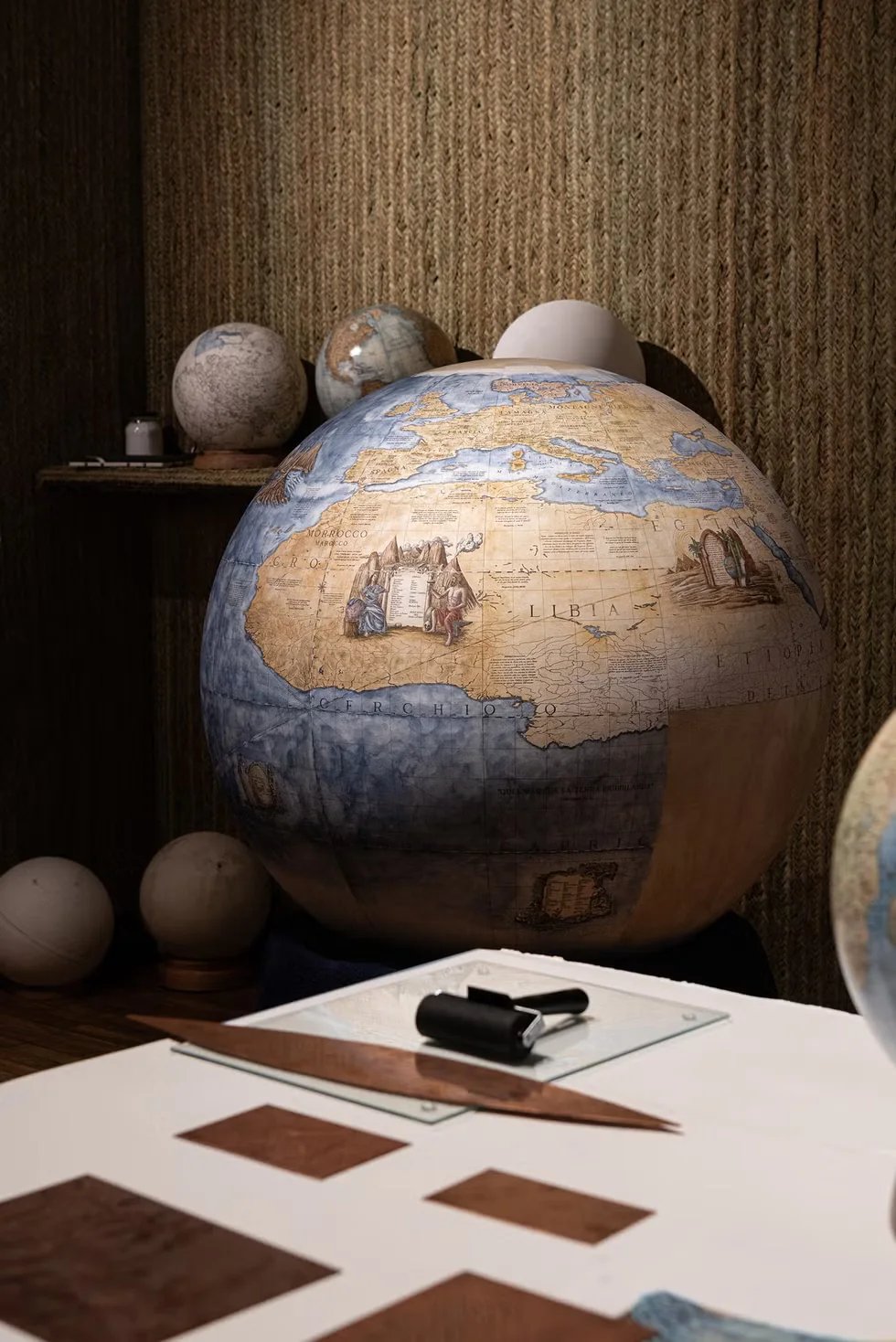
These maps are engraved onto copper plates using traditional engraving techniques. The lines carved into the metal plate hold the ink that will eventually form the printed image.
The plate is then inked and wiped by hand so that ink remains only inside the engraved lines. Damp paper is placed on the plate and run through a traditional printing press. Under pressure the paper absorbs the ink, revealing the map in extraordinary detail.
The printed sheets form the globe’s gores. Each one is carefully cut and then colored by hand using pigments and watercolor. The coloring process is not merely decorative: it reflects centuries old traditions in cartography and map illumination.
Once prepared, the printed gores are applied to a spherical surface. This stage requires patience and precision, as each strip must align perfectly with the others in order to form a continuous map across the globe.
The final result is an object that combines scientific precision with artistic craftsmanship: a globe that is both a map and a work of art.
Terrestrial and Celestial Globes
Frigo’s work includes both terrestrial and celestial globes.
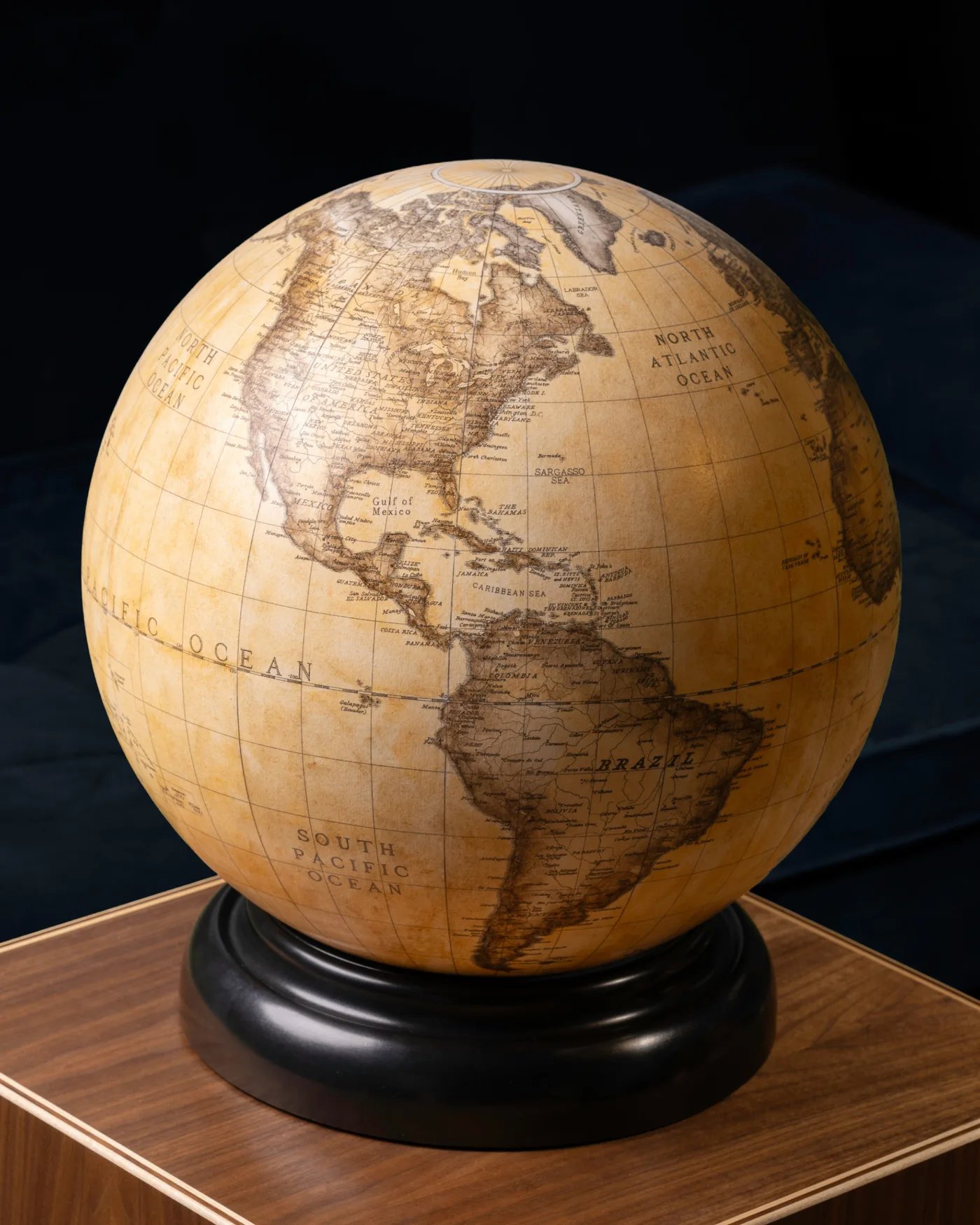
A terrestrial globe represents the geography of Earth, showing continents, oceans and territories. Historically these globes helped scholars understand the physical structure of the planet.
Celestial globes, by contrast, represent the night sky. They depict constellations, stars and mythological figures that have guided astronomers and navigators for centuries.
The constellations are often illustrated with intricate figures drawn from classical mythology — lions, heroes, dragons and other symbolic creatures. These images transform the celestial globe into a poetic representation of the universe.
The Dante Globe Project
One of Leonardo Frigo’s most ambitious works is the Dante Globe.
This project is inspired by the cosmology described in Dante’s Divine Comedy. In the medieval worldview the Earth stood at the center of the universe, surrounded by a series of celestial spheres.
The Dante Globe explores this historical vision of the cosmos, merging art, literature and cartography into a single object.
By studying Dante’s text and medieval cosmological models, Frigo translates poetic descriptions into visual form. The result is a globe that reflects how people in the Middle Ages imagined the structure of the universe.
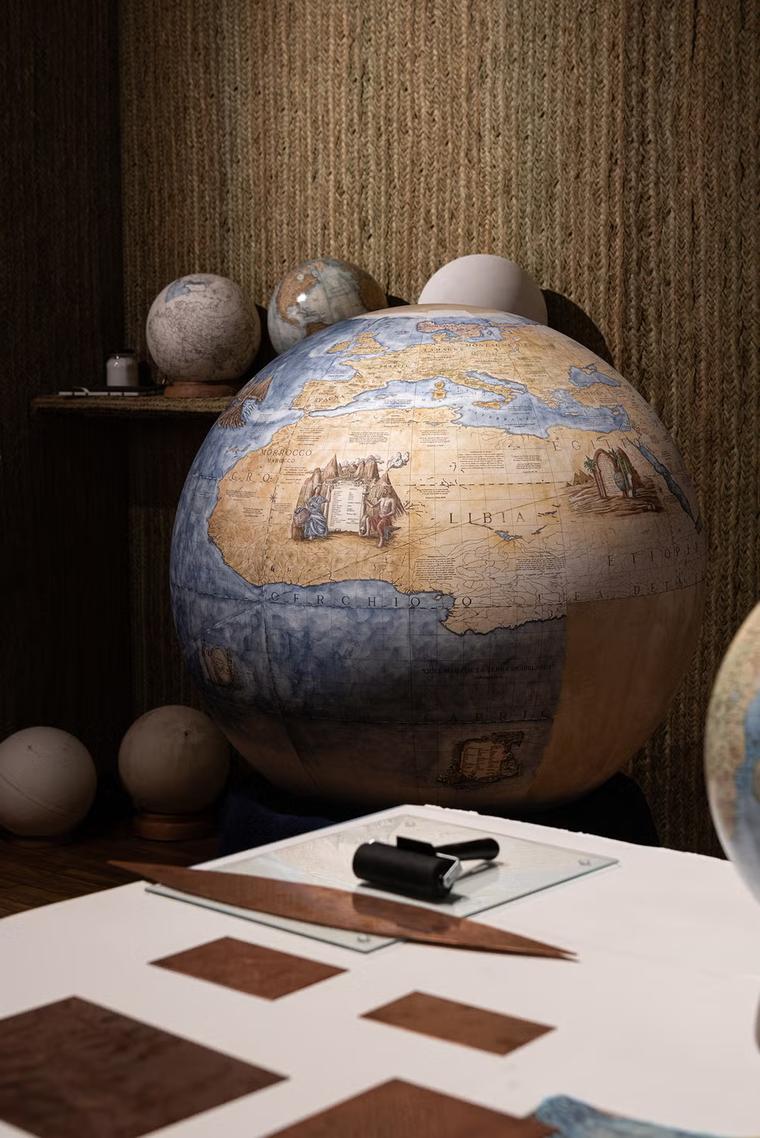
Dante's Globe -Andrea Penisto-
A Timeless Object
The globe remains one of the most powerful symbols of human curiosity. It represents the desire to explore the world and to understand our place within it.
Through his work, Leonardo Frigo reimagines this historical object for the present day. His handmade globes are created for collectors, institutions and individuals who appreciate the meeting point between art, science and history.
From his London studio he continues to explore new projects that bridge past and present. Each globe carries forward a tradition that spans centuries — a reminder that the art of understanding the world can itself be a form of art.