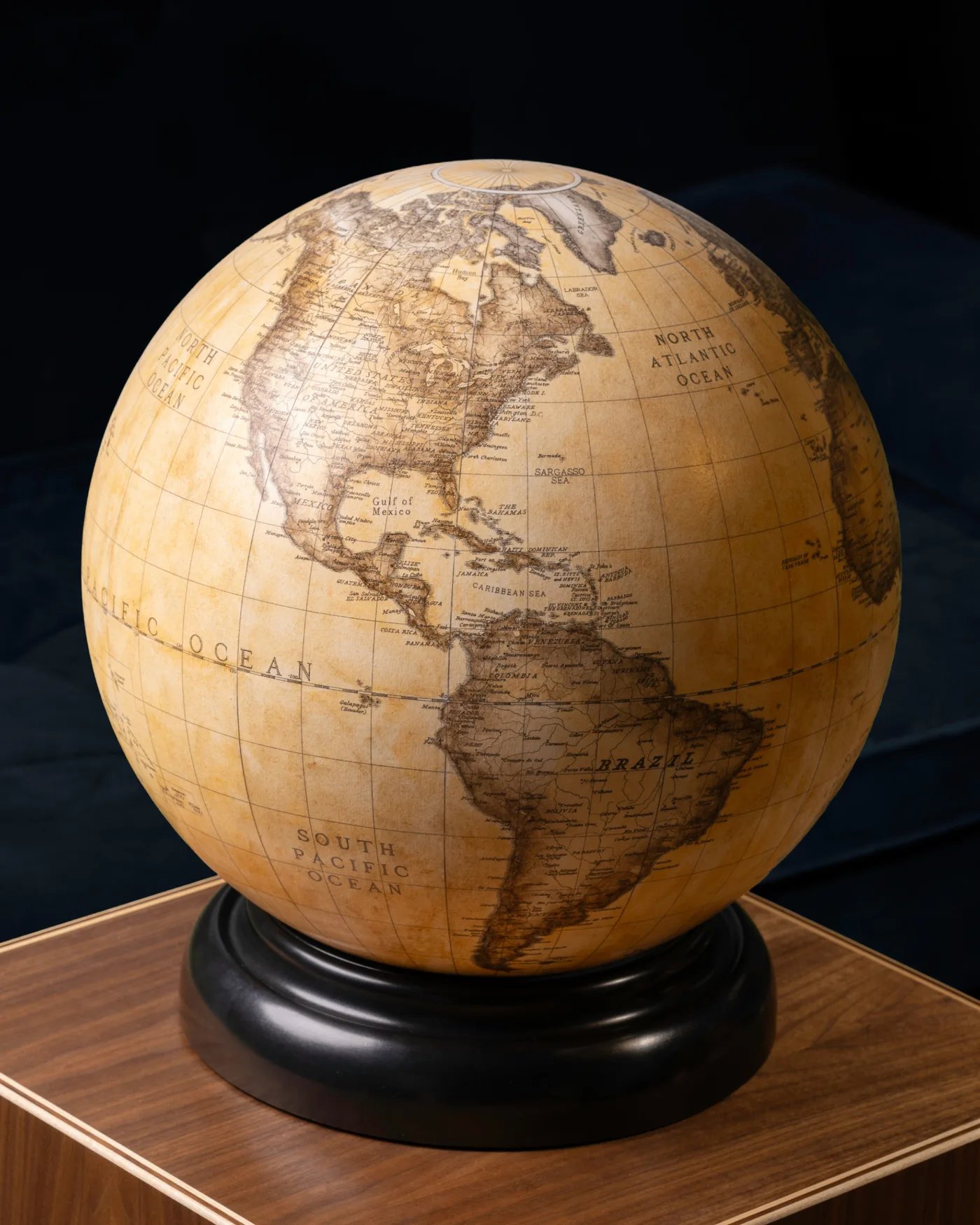
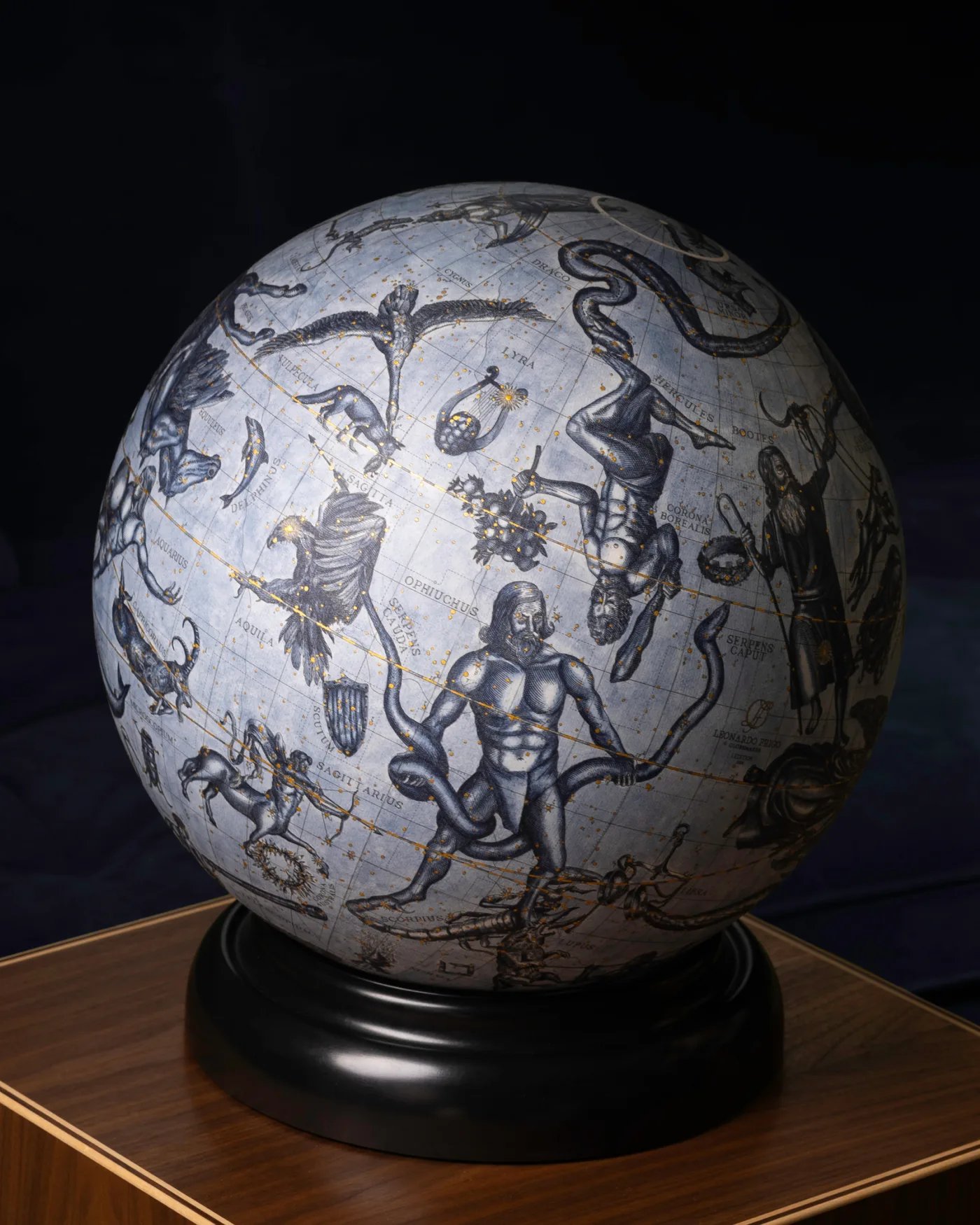
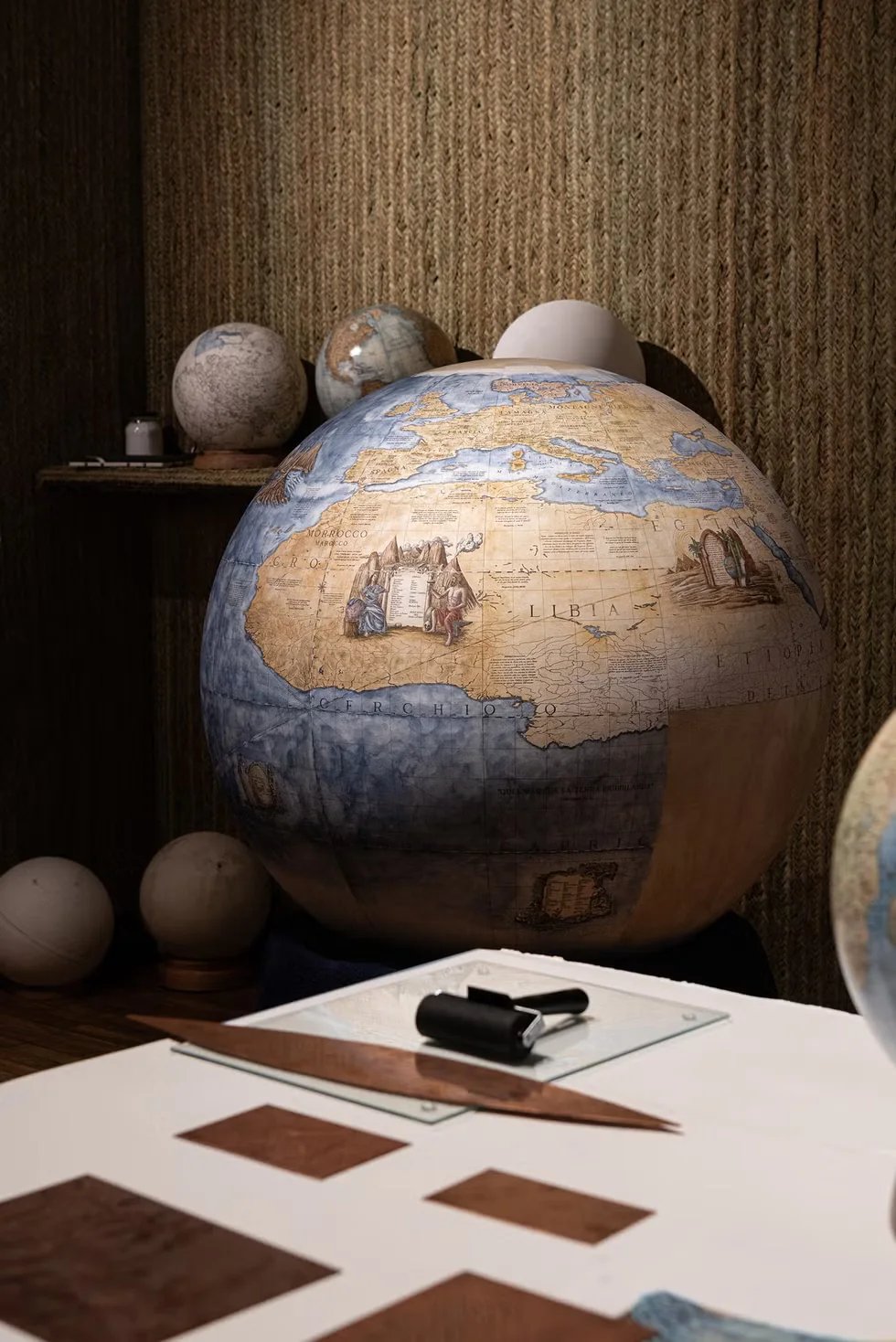
A World In Miniature – Jaeger‑LeCoultre’s Mappemonde
There is a particular kind of light that belongs only to the 1930s. It present itself warm without being yellow, soft without being dim, and it seems to fall across surfaces with the strong confidence of a world that still believed in the future.
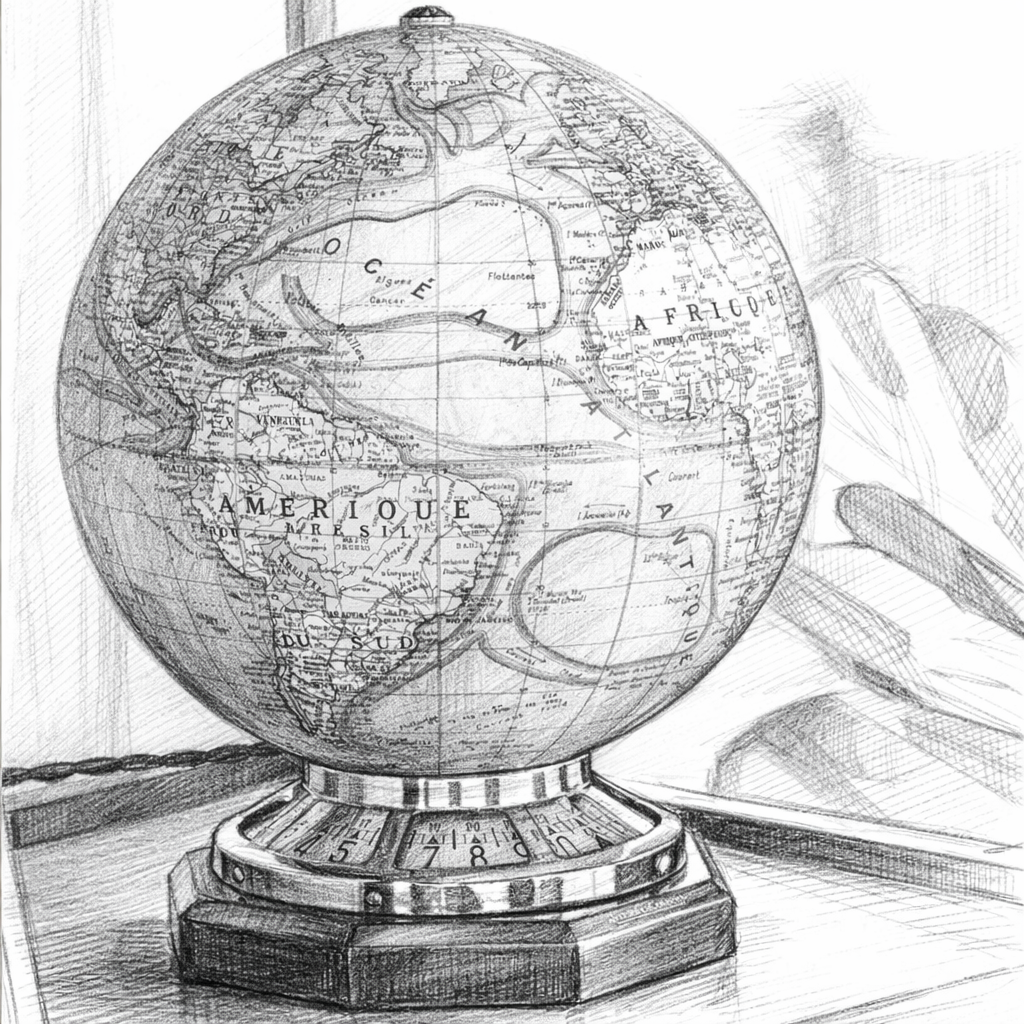
Imagine that same light contained inside a glass sphere the size of a melon, glowing from within like a lantern for the modern eye. The sphere rests on an octagonal base, its edges crisp, its surfaces polished, and its geometry unmistakably Art Deco. Inside, continents float in gentle relief, printed on paper gores that wrap the glass like a second skin.
This is not just a globe. It’s a clock, a lamp, a world timer, and a piece of horological theatre. It is Jaeger‑LeCoultre’s Mappemonde, one of the most quietly magical objects the manufacture ever produced.
Placed on a desk, a bedside table– or really anywhere, the Mappemonde feels like a distilled version of the 30s luxury: functional, decorative, and slightly futuristic for its time. It’s the kind of object that seems to glow even when switched off, as if the idea of illumination were built into its very design. And when lit, it becomes a miniature planet suspended in a chrome armature, a world that tells time.
The 1930s were obsessed with multitasking, and objects with this function were certainly the center of attention. This was the era of the integrated lamp‑clock, the cigarette box with a built‑in lighter, the cocktail shaker with a recipe dial, and the radio that doubled as a piece of sculpture.
Art Deco wasn’t only a style– it was a philosophy of integration. Designers believed that beauty and utility should coexist, and that modern life demanded cleverness. The Mappemonde fits perfectly into this culture of multifunctional luxury. It’s a lamp, but also a clock. It’s a globe, but also a world timer; a piece of cartography, but also a piece of Swiss horology. It is, in other words, the kind of object that could only have been born in a decade that worshipped ingenuity.
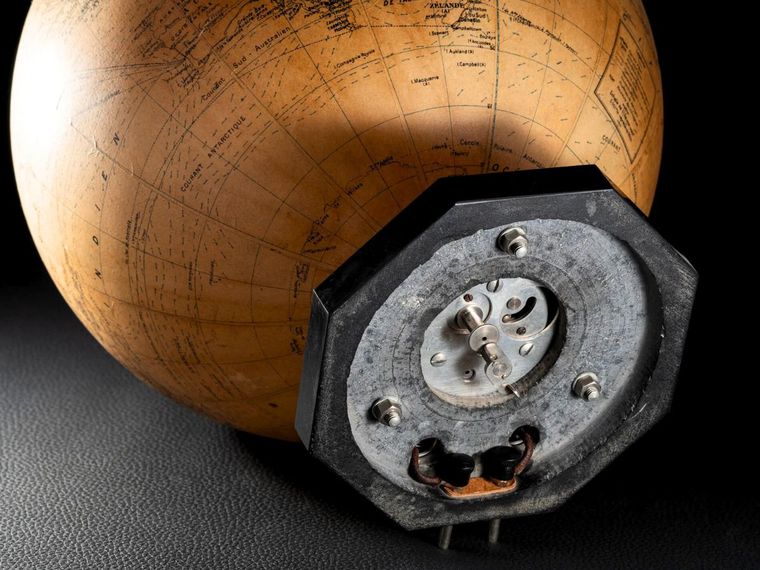
Jaeger-LeCoultre Mappemonde, 1936 - Clock powered by the Jaeger LeCoultre movement 201, a Swiss 8-day hand-winding mechanical movement @Le petite suisse
Turning the Planet to Read the Hour
Jaeger‑LeCoultre referred to this concept as the Mappemonde, a name that captures both its literal function and its poetic ambition. Contemporary experts called it a “world-timer-globe-lamp-clock”, a phrase that sounds almost too modern for something nearly a century old.
Yet, the idea is simply fascinating: combine an eight‑day mechanical movement with an electrically illuminated terrestrial globe, and place both inside a base that allows the user to read approximate world time. The result is a terrestrial globe that feels both practical and dreamlike, a tool for understanding time zones and a decorative sculpture for the desk of someone who wants to feel connected to the vast world.
The configurations are surprisingly intuitive: on the base, two red triangular markers frame a rotating disc divided into a lighter half for day, and a darker half for night. The disc carries two twelve‑hour scales and a twenty‑four‑hour ring, allowing the user to understand the passage of time across the globe.
To set an approximate world time, you can simply align a chosen country on the illuminated sphere with the red markers. It’s not a modern city‑ring world timer, but a more tactile and analogue experience. The globe itself becomes the reference point: you turn the globe to understand the world.
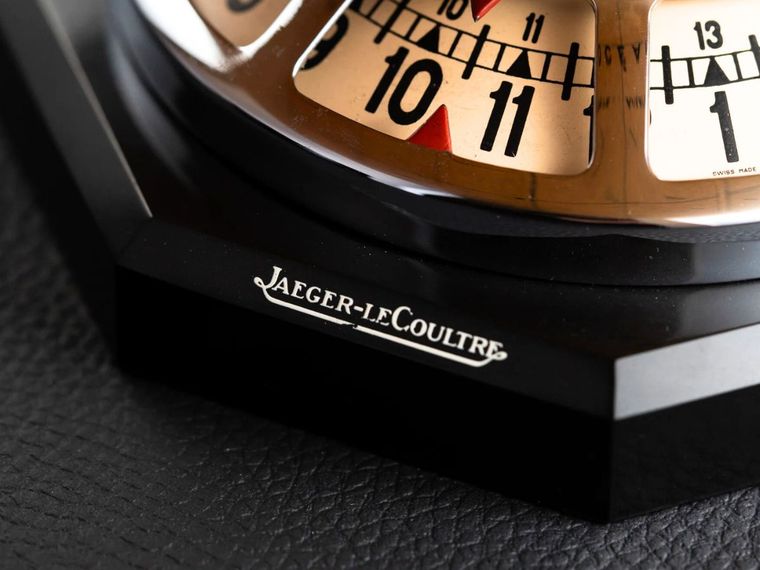
Signature imprint on the Mappemonde @Le petite Suisse
This is where the object becomes more than a clock. It becomes a meditation on time zones themselves, which are, after all, a human invention layered onto a planetary reality. The Earth rotates, so we divided that rotation into hours; but the Mappemonde makes this visible.
When the globe glows from within, the continents appear suspended in a soft halo, and the day‑night disc below becomes a reminder that time isn’t uniform but local, relative, shifting. For a watchmaker, this is a delicate suggestion because watches measure time, but world timers interpret it. The Mappemonde sits at the intersection of these two philosophies: we could say it’s a watchmaker’s attempt to show both the hour and the world in which that time exists.
When Cartography Met Horology
The romance of the Mappemonde deepens when one looks closely at the globe itself. Many examples bear the imprint of J. Forest, 17–19 Rue de Buci (Paris), a cartographic publisher whose address sits in the heart of the city’s historic printing district. Others reference Girard and Barrère et Thomas, Rue de Buci (Paris). These names matter because they reveal a collaboration that feels almost cinematic: a Swiss watchmaker known for precision mechanics partnering with Parisian cartographers known for their printed gores.
The outcome is a hybrid object– part Swiss and French, and part horology and geography. Collectors love this detail because it’s literally written on the map. The imprint on the globe becomes a signature of provenance, a reminder that the Mappemonde is not just a product but a collaboration between crafts.
This synergy is also a reminder of how interconnected the decorative arts once were. Watchmakers worked with glassblowers, cartographers, metalworkers, leather artisans, and electrical engineers. This object embodies a literal ecosystem of hardworkers.
The glass sphere had to be blown to a precise diameter, and the paper gores had to be printed, cut, and applied by hand. The mechanical movement, often identified as “Jaeger” or “Jaeger‑LeCoultre Calibre 201”, had to be engineered to run for eight days and wound through the base.
The electrical wiring had to be routed discreetly so that the lamp function didn’t disrupt the clock function, and the base itself, often in chrome and black marble, had to be weighted and machined to support the globe. Nothing about this object is simple. Everything about it is integrated.
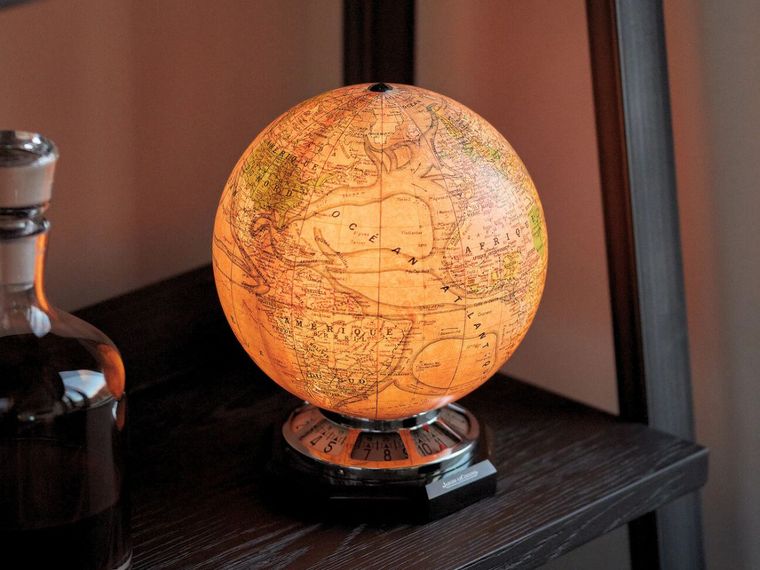
Jaeger-LeCoultre's Illuminated Mappamonde Desk Clock, Ref 163 @Le Petit Suisse
Hermès and the Parisian Connection
Versions of the Mappemonde vary, and these variants tell their own stories. The most common examples feature a chrome base paired with black marble, giving the object an architectural presence; but there are rarer versions where the base is wrapped in leather, often associated with Hermès.
These Hermès‑retailed examples carry a different aura, one that blends horology with Parisian luxury. Some are signed Hermès and marked 8‑Jours, a nod to the eight‑day movement. Antiquorum has noted that these versions may have been designed probably by Paul Dupré‑Lafon, the celebrated designer whose work for Hermès defined a certain strain of French modernism. It’s not officially credited, but adds a layer of collector lore, a whisper of high design that elevates the object from clever to iconic.
The materials and dimensions of the Mappemonde reinforce its presence. The globe typically measures around 20 centimetres in diameter, with a total height between 25 and 29 cm depending on the version. The scale of the map varies by example, with some Hermès versions citing 1:50,000,000 and others 1:65,000,000.
These numbers may seem a bit over the top, but they matter to collectors because they reveal the precision of the cartographic work. A globe is not just a sphere with continents, it’s a mathematical projection translated into curved paper. The scale tells you how the world has been miniaturised.
The Mappemonde’s movement is equally important. Listings that go into technical depth often identify it as Calibre 201, a Jaeger‑LeCoultre movement with a lever escapement and the kind of robust construction expected of an eight‑day clock.
Winding and setting are done through the base, a detail that preserves the purity of the globe’s surface. The lighting is electric, routed through the base as well, which means that collectors today must pay attention to wiring condition and replacements. The electrics are part of the object’s charm, but also part of its fragility.
Patina, Provenance, and Collector Scrutiny
Because the Mappemonde sits at the intersection of so many crafts, collecting it today requires a careful eye. Paper gores are often the first area to show age. Patina is expected, but lifting edges, pinholes, discoloration, and water staining can affect both appearance and value, while the electrics must be checked to ensure the light functions safely.
Many examples have had wiring replaced over the decades. The mechanical movement, even when described as running, usually benefits from a service. After all, an eight‑day movement that has survived nearly a century deserves a careful overhaul.
Signatures and markings are essential for authentication, the base often carries a Jaeger‑LeCoultre plaque and sometimes the reference number 163. These details help establish originality. A globe without its imprint, or a base without its plaque, may still be interesting, but it loses part of its story.
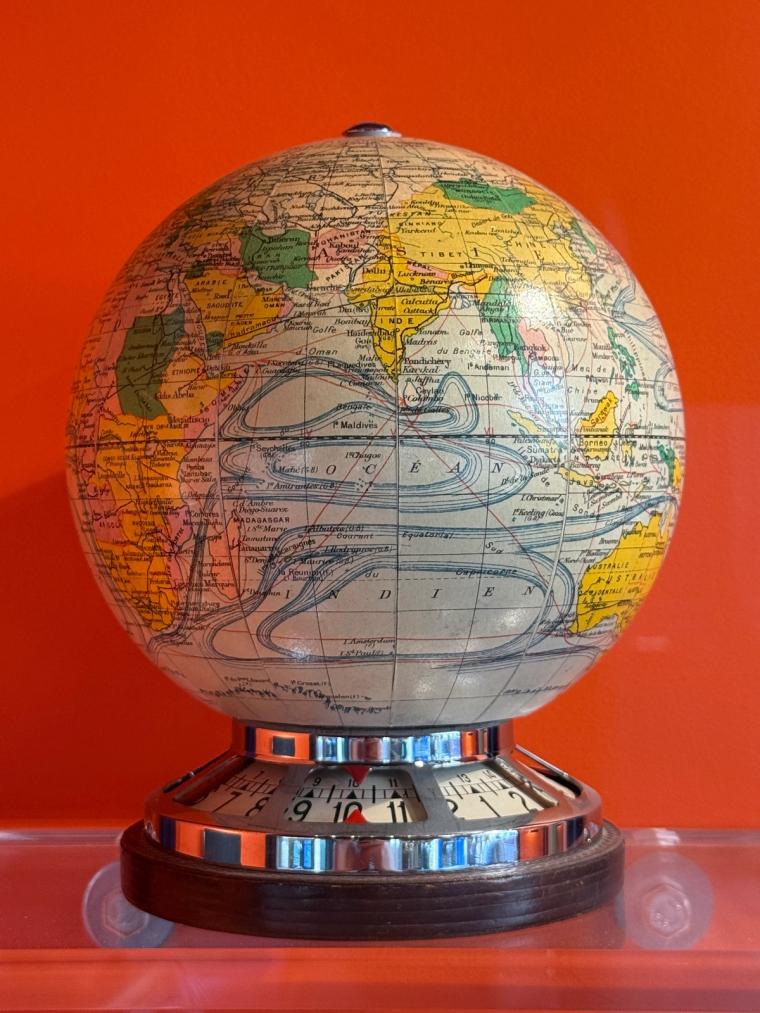
Jeager Lecoultre's Globe Paris 2026
Another interesting point of view is that auction results provide a sense of the object’s market presence without implying any future value. In 2013, Antiquorum New York sold a Ref. 163 Mappemonde for USD 7,500. In 2012, Antiquorum Geneva sold a Hermès‑retailed example for CHF 13,750. More recently, in July 2023, Dawsons recorded a hammer price of £1,600 for a J. Forest globe example.
These numbers vary widely because condition, originality, retailer signatures, and electrics all influence desirability. The spread itself is part of the narrative. It shows that the Mappemonde is not a commodity but a collectible, an object whose value lies in its individuality.
Collaboration as Creative Catalyst
What makes the Mappemonde especially relevant today is the renewed appreciation for multi‑disciplinary craftsmanship. In an era where luxury brands increasingly collaborate with artists, designers, and specialists, this globe feels prophetic. It demonstrates that great objects often emerge from the meeting of different worlds. A watchmaker couldn’t have made it alone– nor could a cartographer, nor a glassblower. Only by working together could something so layered come to life.
This is also why the fascinating Mappemonde resonates with contemporary watchmaking. Today, watches designed for travelers, all wrestle with the same fundamental question: how do you represent a globalised world on a small mechanical stage?
The Mappemonde answers the question with a globe rather than a dial. It shows that time is geographical, that the Earth is always turning, and that understanding time means understanding place.
In a broader sense, this spherical world is a metaphor for the future of craft. It shows that innovation often comes from combining disciplines rather than isolating them. The past was full of such collaborations, the present is rediscovering them, and the future will depend on them. Whether in watchmaking, cartography, lighting design, or digital craftsmanship, the most compelling objects are those that bring different skills into dialogue.
Nearly a century has passed since the Mappemonde was created, yet it carries a strikingly modern presence. A soft glow seems to emanate from within, timeless in quality, while the mechanical movement reflects the honest precision of a master watchmaker.
The printed continents bring a sense of artistry to the piece, balancing function with romantic design. The globe encourages a new way of seeing time, turning the world literally to understand its passage. In doing so, the Mappemonde becomes a meditation on the Earth’s ceaseless rotation, a celebration of evolving art, and a testament to the power of collaboration, weaving together the efforts of watchmakers, cartographers, and artisans across generations.
If Jaeger‑LeCoultre were to revisit this concept today, it wouldn’t feel nostalgic but natural. The manufacture has always excelled at integrating complications, materials, and ideas. The Mappemonde is part of that lineage. It’s a proof to the brand’s willingness to think beyond the wrist and to imagine time as something that can be illuminated, held, and explored.
In the end, this extraordinary spherical item is a small world that contains many others. It’s a lamp, a clock, a collaboration, a piece of history, and a vision of what craftsmanship can achieve when disciplines converge. Its glow is not just light, but a trail of possibility.