Who Made the First Globe? From Ancient Scholars to Contemporary Globemakers
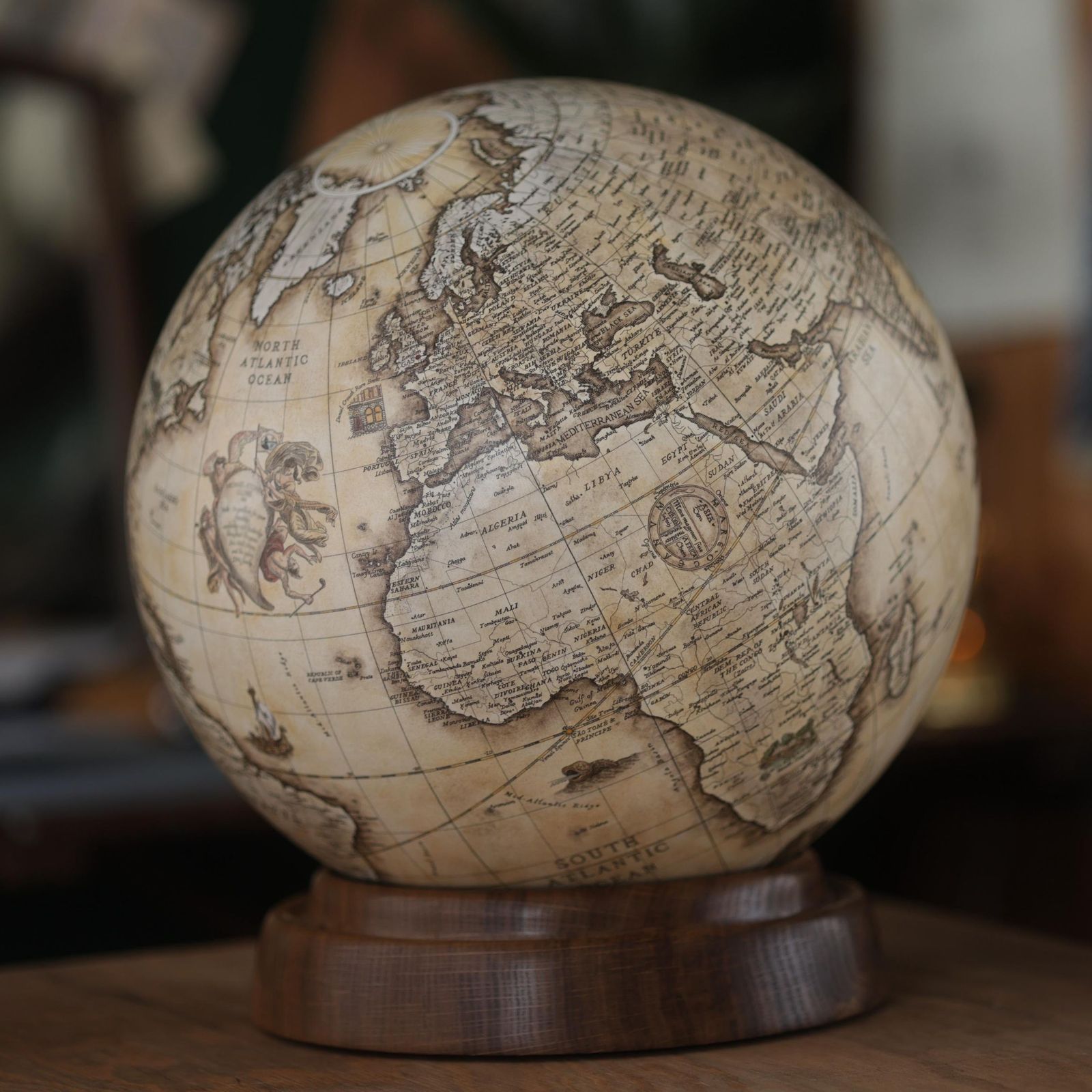
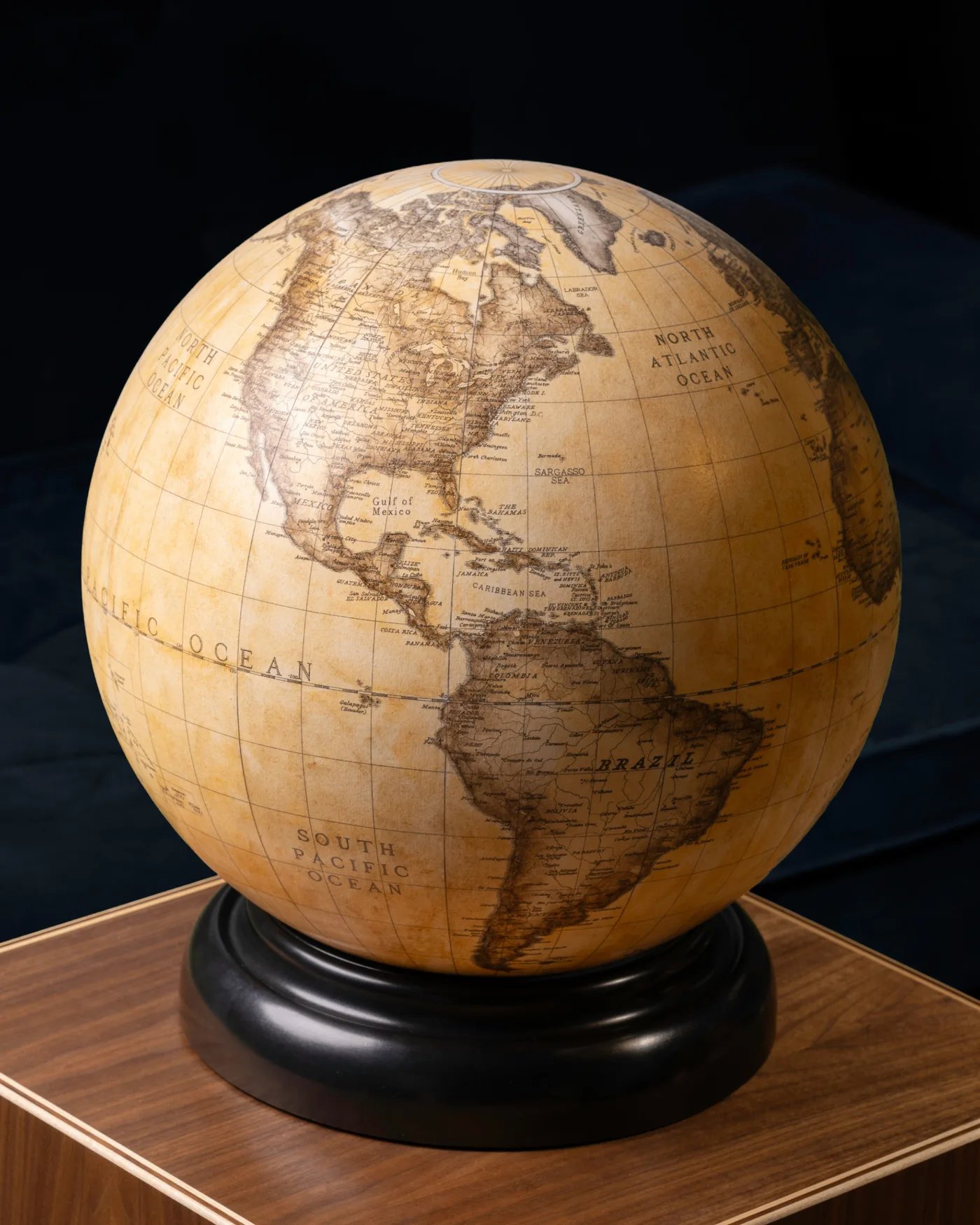
What's the first thing you think of when you hear the word globe? Many recall a classroom as their earliest memory; try to remember: a neat sphere with continents, oceans, and clearly defined borders, usually coloured with vivid hues, sometimes brightened by a light bulb inside it. In short, an object made for learning, but also to intrigue.
Today, we recognise the more modern ones, but the history of the first globe dates back more than two millennia, to a time when geography was as much philosophy as science. And here the question arises: who made the first globe? How was it created, and what was the mindset when it was made?
Some questions remain unanswered, but with all the research conducted over the centuries, including those of Vincenzo Coronelli who revolutionised the way of building globes, today we can reconstruct the history of what we believe to be the first among globemakers.
The First Globemakers in History
The first recorded creator was Crates of Mallus, a Greek philosopher and grammarian who lived in the 2nd century BC. The reconstructions date back to antiquity: according to the ancient geographer Strabo, Crates built what may be the first terrestrial globe ever mentioned in written form.His creation was extraordinary for its time, as it consisted of a sphere approximately three meters in diameter, designed to represent the world known to Hellenistic scholars.
Although none of Crates' craft has survived, his work represents the first documented attempt to model the Earth as a sphere. This alone makes him the earliest identifiable globemaker in history.
The Origins of Bespoke Globes
It's no coincidence the philosopher retained this vision; Crates's globe was born at a time when Greek thinkers were already convinced of the Earth's sphericity. Even Pythagoras and Aristotle had argued for the Earth's shape centuries earlier, but Crates was the first known to have attempted to construct a physical model of the Earth; in a sense, we can describe his as the first bespoke globe.
His sphere lived as a tool for teaching geography and cosmology, helping scholars visualise the layout of land and sea. While its accuracy was obviously limited by the scientific knowledge of the time, the ambition that drove him was remarkable.
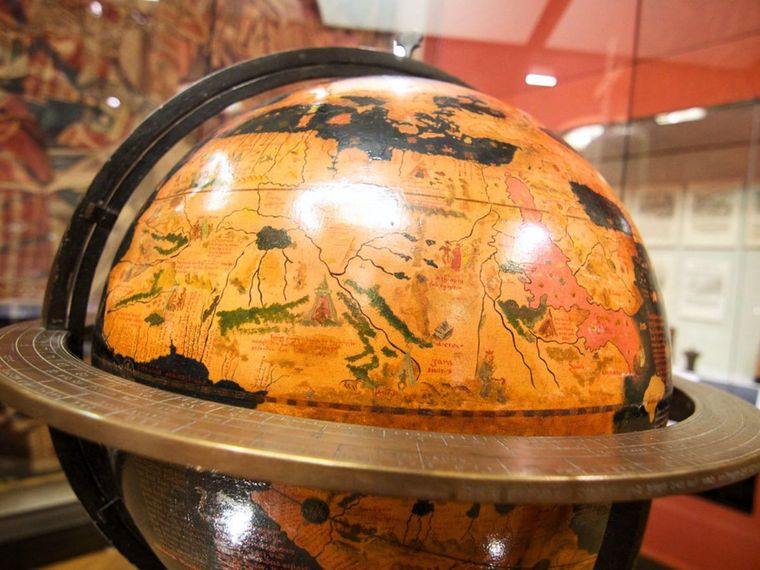
The Erdapfel Globe produced by Martin Behaim, 1492
From Philosophy to Handmade Globes
But despite this early innovation, no physical globes from antiquity have survived, as their fragile nature made them rare and expensive to produce. Many were likely made of wood, leather, or other perishable materials. As a result, historians rely largely on textual references, such as those of Strabo, to reconstruct their existence.
This gap in documentation means that, while Crates is the first known globe thinker, he may not have been the only one to experiment with spherical models of the Earth. Despite this, most museum collections begin much later because the oldest surviving terrestrial globe dates not from antiquity, but from the European Renaissance.
Created in 1492 by Martin Behaim, a German navigator based in Portugal, the Erdapfel is the oldest terrestrial globe still in existence. This is a fascinating object because it reflects the geographical knowledge of Europe shortly before Columbus's first voyage and is therefore completely devoid of the Americas, offering a fascinating snapshot of pre-modern worldviews.
This century brought technological and cultural changes that made global construction more feasible: renewed interest in Ptolemy's Geographica gave new impetus to scientific cartography; increasing maritime exploration created a demand for precise navigational instruments.
The Evolution of Globe Making Craft
These factors transformed globes from rare philosophical objects into practical tools for scholars, sailors, and wealthy patrons. The first represents the conceptual birth of the globe, while the second represents the earliest physical example we can still study today.
Both Crates and Behaim are essential figures in our history. Crates represents the conceptual origin of the idea, while Behaim offers the earliest physical example we can still study today. Understanding who made the first globe helps us appreciate the long human effort to grasp the shape of our planet, an effort that continues today through satellite imaging, digital mapping, and virtual globes.
Globes are cultural artefacts that reveal how humans have understood the world across time. Each one reflects the scientific knowledge, artistic skill, and worldview of its era.
Related Topics
Have we piqued your curiosity about globes? Find out how I brought this nearly forgotten piece of history to life here.